

♥ Wishlist
Compare 27 verified Electric Kettle products in United Kingdom. Reviews, ratings, pros, cons and buying advice updated for November 2026.


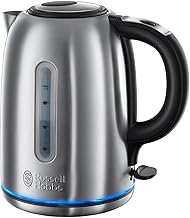


Choosing the right electric kettle involves more than comparing capacity and price. A good kettle should suit the way you use your kitchen, whether you need rapid boiling for several cups of tea, a compact appliance for a small household, precise temperature control for different drinks, or a straightforward everyday model that is easy to fill, operate and clean.
The best electric kettle products for UK households can differ considerably in design, heating performance, controls, capacity, materials and additional features. Popular manufacturers such as Russell Hobbs, Morphy Richards, Breville, Bosch, Philips, Kenwood, Smeg and Dualit offer kettles across different price and feature categories, so it is useful to compare specifications rather than choosing solely by appearance or brand familiarity.
This buying guide explains the most important factors to consider before purchasing an electric kettle in the UK. It covers capacity, power, heating elements, temperature controls, materials, water-level indicators, filters, safety features, energy considerations, cleaning, hard-water management and the differences between kettle types. The aim is to help you identify the specification that actually matters for your household.
A good electric kettle should combine practical boiling performance with convenient everyday operation. There is no single specification that makes one model suitable for everyone. The ideal choice depends on how much water you normally boil, how frequently you use the kettle, whether you prepare different types of hot drinks and how much importance you place on design, noise, controls and maintenance.
For many households, the most useful characteristics include a suitable capacity, efficient heating, a reliable automatic switch-off function, a clear water-level indicator, a comfortable handle, a well-designed spout and a removable or accessible limescale filter. Cordless operation with a 360-degree base can also make a kettle easier to use from different positions on a kitchen worktop.
Premium kettles may add variable temperature settings, keep-warm functions, digital displays or more sophisticated controls. These features can be useful, but they are not essential if your main requirement is simply boiling water for tea, coffee, cooking or other everyday tasks.
Capacity is one of the first specifications worth checking because a kettle that is too small can require repeated boiling, while an unnecessarily large kettle may encourage you to heat more water than you actually need.
Compact kettles are useful for individuals, couples, small kitchens, offices, caravans and households where worktop space is limited. Smaller capacities can also be convenient when you generally prepare one or two drinks at a time.
The main advantage is practicality rather than maximum output. A compact kettle can take up less room and may be easier to fill, carry and store. However, it may be unsuitable for households that regularly need enough boiling water for several people.
Medium-sized models provide a useful balance between capacity and everyday convenience. They are often suitable for couples, small families and general kitchen use where the kettle is regularly used throughout the day.
When comparing models in this category, look beyond the maximum capacity. Check the minimum fill level as well. A kettle with a high minimum-fill requirement may use more water than necessary when preparing a single drink.
Larger kettles can be useful for families, shared kitchens and occasions when several cups are prepared together. They can reduce the need for multiple boiling cycles, particularly when preparing hot water for cooking.
However, larger capacity does not automatically mean better performance. A larger kettle may occupy more worktop space and can be heavier when full. Consider whether you genuinely need the additional capacity before selecting a larger model.
Maximum capacity receives considerable attention in product specifications, but minimum fill is an important practical measurement that is often overlooked. If you generally make one cup at a time, a kettle with a lower minimum operating level may be more convenient.
Look for a clearly marked water-level indicator that makes it easy to judge the amount of water required. Some kettles include cup markings, although the accuracy and usefulness of these markings can vary between designs.
For everyday use, the most efficient habit is to boil approximately the amount of water required rather than filling the kettle to its maximum level every time.
Electric kettles commonly use high electrical power because they are designed to heat water quickly. The wattage shown in the specification tells you how much electrical power the appliance can draw while operating, but wattage alone does not tell the entire story about real-world boiling performance.
Heating performance can also be influenced by the amount of water being heated, starting water temperature, heating-element design, kettle construction and control system. Comparing wattage is therefore useful, but it should not be treated as a complete measure of quality.
For buyers who prioritise rapid boiling, look at the manufacturer's stated performance information alongside capacity and other specifications. A high-powered kettle can be useful when several drinks need to be prepared quickly, but it should still be matched to the electrical requirements and operating environment of the intended kitchen.
No. Higher wattage can support faster heating under suitable conditions, but it is not a universal quality indicator. A kettle with a sensible power rating, efficient heating system, suitable capacity and good controls may be a better purchase than a model selected purely because its wattage is higher.
Buyers should also remember that electricity consumption depends on how much water is heated and how often the kettle is operated. Heating twice as much water unnecessarily can matter more to everyday consumption than choosing between two relatively similar power ratings.
The heating element is responsible for transferring electrical energy into the water. Modern electric kettles commonly use concealed heating elements beneath the base of the water chamber.
A concealed element has practical advantages because it keeps the electrical heating component away from direct exposure to water and provides a relatively smooth internal surface. This can make cleaning easier than with older exposed-element designs.
When comparing kettles, inspect how accessible the interior is around the base and whether the design appears straightforward to clean. Limescale can accumulate around heating areas, particularly in hard-water regions, so internal accessibility is an important long-term consideration.
The material used for the kettle affects appearance, weight, heat retention, cleaning and durability. There is no universally superior material; the best choice depends on your priorities.
Stainless steel kettles are popular because they can provide a solid, premium-looking appearance and are available across a wide range of designs. Stainless steel can also make a kettle feel substantial and robust.
Potential disadvantages include greater weight compared with some plastic models and the possibility of fingerprints or water marks becoming visible on polished finishes. Some stainless-steel kettles may also have hotter exterior surfaces during or shortly after boiling, depending on their construction and insulation.
Plastic kettles are often lightweight and practical. They can be easier to handle when full and are available in numerous colours and shapes.
For buyers considering a plastic kettle, examine the construction quality, handle design, lid mechanism and overall finish rather than assuming that all plastic models offer the same durability.
Glass kettles offer a clear view of the water and can create an attractive appearance in a modern kitchen. Being able to see the water level directly can be convenient.
The trade-off is that transparent surfaces can make limescale more noticeable. Buyers should therefore pay particular attention to cleaning access and the design of the filter and lid.
Variable-temperature kettles are particularly useful for people who prepare a range of hot drinks. Instead of bringing all water to the same temperature, these models allow the user to select a target temperature or temperature range.
This can be useful for different types of tea, coffee preparation and other beverages where boiling water is not always the preferred choice. Exact requirements vary according to the drink and preparation method, so buyers should consider whether they will genuinely use the temperature settings.
If you mainly boil water for standard tea, instant coffee or cooking, variable temperature control may not provide enough practical benefit to justify prioritising it over other features.
A keep-warm function is designed to maintain heated water at a selected temperature for a period of time. It can be useful if you prepare several drinks gradually rather than using the entire kettle immediately.
However, maintaining water at temperature requires additional energy compared with switching the kettle off after boiling. If you generally make a drink immediately after boiling, this feature may have limited value.
Consider the way you actually use the appliance before paying extra for functions that may rarely be activated.
A clear water-level indicator is one of the most useful everyday features on an electric kettle. It allows you to fill the appliance accurately instead of repeatedly opening the lid to check the amount of water inside.
Look for indicators that are easy to read from the normal filling position. Indicators placed behind handles can sometimes be less convenient depending on the kettle's orientation and your kitchen layout.
Some models include markings for individual cups as well as maximum capacity. These markings can be particularly useful for reducing unnecessary boiling.
Limescale is an important consideration for many UK households because water hardness varies considerably by region. Minerals in hard water can gradually form deposits inside an electric kettle.
A removable or accessible limescale filter can help prevent loose deposits from entering a cup when water is poured. The filter does not eliminate limescale from the kettle itself, so regular descaling remains important where mineral deposits build up quickly.
Accumulated limescale can affect the appearance of the kettle, reduce the cleanliness of the internal surfaces and interfere with the normal operation of the heating area. Heavy deposits may also make the appliance increasingly difficult to clean.
Regular maintenance is therefore an important part of getting reliable long-term use from an electric kettle.
Always follow the cleaning and maintenance instructions supplied with the specific kettle. Different manufacturers can have different recommendations regarding suitable descaling products and procedures.
The frequency of descaling depends on water hardness and how frequently the kettle is used. A household in a hard-water area may need to descale more often than a household in a softer-water region.
Safety should be a fundamental consideration when comparing electric kettles. Automatic switch-off is an important feature because the kettle is designed to stop heating after the water reaches boiling conditions or when its control system detects the relevant operating state.
Many kettles also include boil-dry protection, which is intended to prevent continued heating when insufficient water is present. The exact operation of safety systems varies by product, so check the manufacturer's specifications when safety features are particularly important to your purchasing decision.
A kettle may look excellent on a product page but still feel inconvenient if the handle does not suit your hand or if the balance is poor when the appliance is full. Ergonomics therefore deserve attention during comparison.
A comfortable handle should provide a secure grip and allow controlled pouring. The relationship between the handle, spout and water chamber affects how naturally the kettle feels when tilted.
This is particularly important for heavier stainless-steel and glass models, where the full weight of the kettle can be noticeably greater than that of a lightweight plastic alternative.
The spout influences how easily water can be directed into a mug, teapot or cooking container. A well-designed spout should provide controlled pouring without requiring excessive tilting.
Buyers who regularly pour into smaller cups or use a kettle for manual coffee preparation may place greater importance on pouring precision than buyers who simply transfer boiling water into a large pan.
Do not evaluate a kettle only on maximum boiling speed. Pouring control, lid operation and handling can have a greater effect on everyday satisfaction.
Different kettles use push-button lids, hinged lids, removable lids or designs where the opening is integrated into the top of the appliance. Each approach has practical advantages.
A wide opening can make it easier to fill and clean the kettle. A narrow opening may make cleaning the internal surfaces more difficult, especially when mineral deposits accumulate around the base.
Check whether the lid opens far enough to allow comfortable filling beneath a tap. Also consider whether the mechanism can be operated easily when the kettle is being used frequently.
Most modern electric kettles separate from their electrical base, allowing the user to lift and pour without carrying the power cord. A 360-degree connector can make the kettle easier to position from different directions.
This is particularly useful in kitchens where several people use the appliance or where the kettle needs to be placed in different orientations on the worktop.
When assessing the base, consider its footprint, stability, cord management and how easily the kettle connects and disconnects.
Integrated cord storage can help keep the worktop tidy and reduce unnecessary cable length. This is a relatively small feature, but it can be useful in compact kitchens where every centimetre of worktop space matters.
Before choosing a kettle, consider where the base will sit, where the cable will run and whether the lid or water-level indicator remains easy to access in that position.
Boiling water naturally creates sound, but the perceived noise of an electric kettle can differ according to its construction, water level and heating system.
Noise may be worth considering if the kettle is used early in the morning, in an open-plan kitchen or close to living or working areas. Product specifications do not always provide a directly comparable noise measurement, so buyers should be cautious about treating vague claims about quiet operation as a precise performance guarantee.
One of the simplest ways to reduce unnecessary electricity use is to boil only the amount of water required. Filling a kettle to its maximum capacity for a single cup means heating water that may never be used.
For households that use an electric kettle many times each day, accurate filling can make a more meaningful difference to routine energy use than focusing exclusively on small differences between similar kettle power ratings.
Automatic switch-off also helps prevent the kettle from continuing to heat once its normal boiling cycle has completed, although users should still operate the appliance according to the manufacturer's instructions.
Not every additional feature provides equal value. When comparing products, separate genuinely useful functions from features that mainly add complexity or visual appeal.
When comparing two or more electric kettles, use the same criteria for each product. This avoids making a decision based on whichever specification is most prominently advertised.
For general household use, prioritise a sensible capacity, rapid and consistent heating, a clear water-level indicator, automatic switch-off and easy cleaning. A straightforward kettle from an established manufacturer such as Russell Hobbs, Breville, Bosch, Philips or Morphy Richards can provide the core functionality without requiring specialist controls.
Compact dimensions and a suitable smaller capacity should be the priority. Look at the base footprint as well as the kettle body because the base often determines how much permanent worktop space the appliance occupies.
A larger capacity can be useful when several people need hot drinks around the same time. A well-designed handle and stable base become increasingly important as the filled kettle becomes heavier.
A variable-temperature model may be worth considering if you regularly prepare different types of tea. Temperature presets or adjustable controls can offer more flexibility than a basic boil-only kettle.
Coffee-focused buyers may place greater importance on temperature control and pouring accuracy. If precise manual pouring is important, consider the shape and control of the spout rather than concentrating solely on maximum capacity.
Brands such as Smeg, Dualit, Russell Hobbs and Breville offer distinctive kettle designs across different product ranges. When appearance is a priority, consider how the kettle's finish will look after regular use as well as how easy it will be to clean.
A higher purchase price does not automatically mean a kettle will be better for every household. Premium models may offer superior materials, more sophisticated controls, distinctive designs, temperature management or additional convenience features.
Budget kettles can be perfectly suitable when the main requirement is straightforward boiling. The important comparison is whether the additional features of a more expensive model solve a genuine problem for you.
Instead of asking whether an expensive kettle is better in absolute terms, ask whether its additional capabilities are useful enough to justify the difference for your particular use.
A very large kettle may look versatile, but if most boiling involves one or two cups, a smaller model may be easier and more efficient to use.
This can be particularly inconvenient for individuals and couples. Always check how much water the kettle requires for safe operation.
Design is important, but a beautiful kettle with an awkward lid, poor water-level visibility or difficult cleaning access may become frustrating over time.
Wattage should be considered alongside capacity, heating design and the manufacturer's specifications. It is only one part of the performance picture.
Buyers in hard-water areas should consider filter design, internal accessibility and descaling requirements before making a decision.
Temperature control, displays and keep-warm functions can be valuable, but only when they match your routine. A simple kettle may be the more sensible choice for users who only need boiling water.
A kettle that feels light when empty can become considerably heavier when filled. Consider the full operating weight if the appliance will be used by people who may find heavier models difficult to handle.
Family buyers should consider both capacity and handling. A large kettle can reduce repeated boiling, but it also becomes heavier when full. A broad, comfortable handle and stable base can therefore be just as important as the headline capacity.
Also consider the water-level indicator. When several people use the same appliance, simple markings can encourage more accurate filling and make the kettle easier for everyone to operate consistently.
An office kettle may experience frequent use by multiple people, making durability, capacity, ease of cleaning and straightforward controls particularly important.
A kettle that is simple to understand can be preferable in a shared environment. Features that require additional explanation may offer less practical value than reliable basic operation and easy maintenance.
Regular cleaning helps maintain the kettle's internal and external surfaces. Water deposits should not be allowed to accumulate indefinitely, particularly in areas with hard water.
Do not use cleaning methods that conflict with the manufacturer's instructions, particularly aggressive chemicals or abrasive materials that could damage the kettle.
Water hardness is a practical factor that is sometimes ignored during product research. In areas with harder water, visible limescale can develop more quickly, increasing the importance of a removable filter and accessible internal surfaces.
If you live in a hard-water area, compare kettles with maintenance in mind. A model that is easy to descale and has a straightforward filter may be more convenient over the long term than a kettle selected purely for its appearance.
The exterior construction affects how the appliance behaves during use. Some kettles have double-wall or insulated constructions designed to reduce external heat and retain warmth, while simpler single-wall designs can become noticeably hot.
Do not assume that every kettle made from the same material will have the same exterior temperature characteristics. Construction and insulation are equally important, so check the manufacturer's safety and handling information for the specific model.
An electric kettle is handled repeatedly, often several times every day. Small ergonomic differences can therefore become significant over months and years of use.
Look at the relationship between the handle, lid release, water-level indicator and spout. The ideal arrangement allows you to fill, lift, pour and replace the kettle naturally without awkward movements.
For households with different users, simplicity is often an advantage. A kettle should be comfortable for the people who will actually operate it, rather than being chosen only for its technical specification.
Product pages can contain a large amount of information, but specifications are not always presented in the same order. Before purchasing, create a short checklist and verify the important details.
Customer reviews can provide useful information, but they should be interpreted alongside technical specifications rather than treated as the sole source of evidence.
Look for recurring comments about specific practical issues such as lid operation, pouring control, limescale build-up, handle comfort, water-level visibility, noise or long-term usability. A single review may describe an individual experience, whereas repeated comments can highlight a pattern worth investigating.
It is also useful to distinguish between reviews discussing the product itself and comments about packaging, delivery or retailer service. For an independent product comparison, focus primarily on feedback that relates directly to the kettle's design and operation.
Brand reputation can be useful as a starting point, but it should not replace product-level comparison. Russell Hobbs, Breville, Morphy Richards, Bosch, Philips, Kenwood, Smeg and Dualit cover different design approaches and price segments, and the specifications can vary considerably between individual models.
When comparing brands, examine the specific kettle rather than assuming that every model from one manufacturer offers the same features. Capacity, heating system, temperature controls, materials, filter design and warranty terms can differ substantially across product ranges.
The most reliable buying process is therefore to use brand reputation as one consideration, then compare the exact specifications and independent customer feedback for the models you are considering.
A quick specification checklist can make commercial comparison much easier:
A basic kettle can be the most sensible option when your requirements are straightforward. If you mainly boil water for tea, coffee or cooking, additional digital controls may not provide meaningful benefits.
Simple controls can also make an appliance easier for every member of the household to operate. Fewer components may mean fewer settings to understand, although durability always depends on the design and construction of the individual product.
A premium kettle becomes more compelling when you have specific requirements that justify its additional features. Variable temperature control is a good example because it can provide functionality that a basic boil-only model cannot.
Premium construction may also appeal to buyers who place significant importance on materials, design, insulation, controls and overall finish. The important point is to identify the features you will actually use before spending more.
For buyers comparing electric kettles in 2026, the most useful approach remains specification-led rather than trend-led. Newer models may introduce updated controls, displays, finishes or connected features, but those additions should be assessed according to practical value.
A strong buying decision starts with capacity and usage, followed by heating performance, handling, safety and maintenance. Only after these fundamentals have been considered should decorative design and additional smart features become major deciding factors.
As product specifications, prices and availability can change, check the latest manufacturer information and current retailer listings before purchasing. This is particularly important when comparing models from previous product generations with newer releases.
The best electric kettle depends on your capacity requirements, budget, preferred materials, boiling habits and desired features. A suitable everyday kettle may need only reliable heating, good handling, automatic switch-off and easy cleaning, while tea and coffee enthusiasts may prefer variable temperature control.
Choose a capacity based on the number of cups you normally prepare. Smaller households may prefer a compact model, while families and shared kitchens may benefit from a larger capacity. Also check the minimum fill level rather than looking only at maximum capacity.
Stainless steel can provide a robust and premium appearance, but it is not automatically better for every user. Plastic and glass models can have their own advantages in terms of weight, visibility, design and handling. Compare the complete construction rather than choosing solely by material.
Higher wattage can support faster heating under suitable conditions, but wattage alone does not determine overall quality. Capacity, heating design, water volume and construction should also be considered.
They can be worthwhile if you regularly prepare drinks that benefit from different water temperatures. If you mainly need boiling water for conventional tea, instant coffee or cooking, a basic kettle may offer better value and simpler operation.
There is no single schedule suitable for every household. Descaling frequency depends on water hardness and how frequently the kettle is used. Follow the manufacturer's maintenance instructions and descale when mineral deposits become noticeable.
A limescale filter is designed to help prevent loose mineral deposits from being poured into your drink. It does not replace descaling because mineral deposits can still accumulate inside the kettle.
Material can influence weight, appearance, cleaning, durability and exterior heat characteristics. However, performance depends on the complete design, including the heating system, power rating, insulation and controls.
Glass can make mineral deposits particularly visible, but that visibility can also make it easier to recognise when cleaning is required. The ease of maintenance depends on the specific lid, opening, filter and internal design.
Automatic switch-off and boil-dry protection are important features to look for. A stable base, secure handle and suitable lid design also contribute to practical safety. Always follow the manufacturer's operating instructions.
Measure the amount of water you actually need instead of filling the kettle to maximum capacity for every use. Avoid repeatedly boiling more water than necessary, and use the kettle according to the manufacturer's recommended operating instructions.
Choose one if you regularly need heated water to remain available for a period of time. If you normally make your drink immediately after boiling, the feature may not provide enough practical benefit to be important in your purchase decision.
Look for a kettle with an accessible or removable limescale filter, an easy-to-clean interior and clear maintenance instructions. The best choice also depends on how frequently you are prepared to descale the appliance.
They can be worthwhile when their additional materials, controls, temperature settings, insulation or design features provide benefits you will actually use. A more expensive kettle is not automatically a better choice for someone who only needs straightforward boiling.
The best electric kettle is ultimately the one that matches your daily routine rather than the one with the longest feature list. Start with capacity, minimum fill level and handling. Then compare heating performance, safety systems, water-level visibility, filtration and cleaning requirements.
If you want specialist control, consider variable temperature settings. If you have limited worktop space, prioritise compact dimensions. If your area has hard water, place greater emphasis on filtration and descaling. If several people use the appliance, consider capacity, handle comfort and simple controls.
Brands including Russell Hobbs, Breville, Morphy Richards, Bosch, Philips, Kenwood, Smeg and Dualit provide useful starting points for product research, but the exact specification of each model should always be checked before purchase. Compare current specifications, read verified customer reviews, check today's prices from trusted retailers and make the final decision according to your actual requirements.