

♥ Wishlist
Compare 21 verified Festool Cordless Torches & Lighting products in United Kingdom. Reviews, ratings, pros, cons and buying advice updated for October 2026.
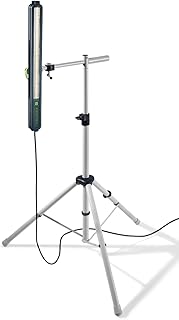






Choosing the right Festool cordless torch or work light is less about buying the brightest lamp and more about matching the light to the job. A compact inspection light can be ideal for illuminating a cabinet, service void or awkward corner, while a higher-output cordless construction light is better suited to a room, workshop or larger site area.
Festool's SYSLITE range covers several distinct lighting requirements, from compact portable working lights to larger construction lights and specialist surface-inspection equipment. The important distinction is that not every SYSLITE product is cordless, so buyers should check the power source, battery compatibility and intended application rather than assuming every Festool light operates from an 18V battery.
For UK buyers comparing Festool cordless lighting in 2026, the most useful factors are light output, beam distribution, colour temperature, battery compatibility, runtime, mounting flexibility, protection against dust and moisture, portability and the size of the area that needs illuminating.
Lighting is part of the working environment, not simply an accessory. Poor illumination can make it harder to see edges, joints, scratches, defects, fixings, measurements and changes in surface quality. A bright light positioned incorrectly can also create harsh shadows or glare, which means a higher lumen rating does not automatically produce better visibility.
The most effective work light is one that puts useful light where it is needed without forcing the user to hold the lamp continuously. This is why mounting systems, swivelling heads, magnets, hooks, tripod compatibility and adjustable brightness can be just as important as maximum output.
For tradespeople, another advantage of cordless lighting is freedom from mains cables. A battery-powered light can be moved around a room or site without routing an additional cable across the floor. This can make repositioning easier and reduce the number of trailing cables around the work area.
The Festool SYSLITE KAL C is one of the more compact options in the current SYSLITE lighting range. It is intended to be carried with the user and used close to the immediate work area rather than functioning as a replacement for a large construction floodlight.
Its specification includes an 18V battery system, a maximum luminous flux of 1,200 lumens, three brightness settings and a 5,000 K colour temperature. Festool specifies a colour rendering value above 80 Ra and an IP54 housing protection rating without the battery pack.
The lamp head can be swivelled through a 0–180-degree range, allowing the user to redirect the light without repeatedly moving the entire body of the lamp. It can also be hung from a hook or mounted to a tripod using its 1/4-inch thread.
Festool states that the KAL C is compatible with its 18V battery packs except Ergopack batteries. The manufacturer's stated runtime at maximum luminous flux is up to 360 minutes with a 4.0 Ah battery pack and up to 450 minutes with a 5.0 Ah battery pack. Actual runtime naturally depends on brightness setting, battery condition, temperature and working conditions.
The Festool SYSLITE KBS C occupies a different position from the compact KAL C. It is a cordless construction light designed to illuminate a medium-sized working area rather than simply providing close-up light.
Festool specifies up to 5,000 lumens, infinitely adjustable brightness, a 5,000 K colour temperature and a colour rendering value above 80 Ra. Its published protection rating is IP54, and the unit is designed for positioning on the floor, wall, tripod or suitable metal surfaces using integrated magnets.
The housing can be swivelled so that the light can be directed from different positions. This is particularly useful when working across floors, walls and ceilings because the user can change the direction of illumination without having to redesign the entire setup.
Festool states that the KBS C is compatible with its 18V battery packs except Ergopack batteries. At maximum output, the manufacturer's stated operating time is up to 120 minutes with a 4.0 Ah battery pack and up to 150 minutes with a 5.0 Ah battery pack.
The KAL C and KBS C should not be viewed simply as two versions of the same product. They address different lighting jobs.
Lumens measure the total amount of visible light emitted by a source. They are useful when comparing the overall output of work lights, but they do not tell the whole story.
A lamp producing a high lumen output may distribute that light over a broad area. Another lamp with fewer lumens may concentrate its output into a smaller region and therefore appear brighter on a particular work surface.
For this reason, do not choose a cordless work light solely by searching for the highest lumen number. Consider the intended working distance, beam distribution, mounting position and the amount of area that needs to be illuminated.
Broad illumination is useful when working in a room because it reduces the need to reposition the lamp repeatedly. More concentrated illumination can be preferable for inspection, detailed assembly or working inside a restricted space.
A good buying decision therefore starts with the question: How much area needs useful light? It should not start with: Which lamp has the highest lumen rating?
Colour temperature affects the appearance of the light. Festool's current KAL C and KBS C specifications use a 5,000 K colour temperature, giving the light a daylight-like appearance.
This can be useful for detailed workshop and construction tasks where the user wants a neutral-looking working environment. However, colour temperature should not be confused with colour rendering.
These measurements answer different questions. Comparing them as though they were interchangeable can lead to poor purchasing decisions.
If you already use Festool cordless tools, battery compatibility can be a major reason to choose a Festool work light. However, compatibility should always be checked against the exact model and battery generation rather than assumed from the brand name alone.
The current KAL C and KBS C specifications identify compatibility with Festool 18V battery packs, with Ergopack excluded. Buyers should therefore check the exact battery requirements before placing an order, particularly when purchasing a body-only configuration.
A higher-capacity battery can generally provide more energy for longer operation, but it can also add weight and bulk. For a compact torch that is carried continuously, the lightest practical battery may be preferable. For a stationary construction light, additional battery capacity may be more acceptable because the lamp can remain positioned while the user works.
Published runtime should also be treated as a guide rather than a guarantee for every situation. Maximum-output operation generally places greater demand on the battery than lower brightness settings. Temperature, battery age, workload and battery condition can also influence practical performance.
An IP rating describes protection provided by an enclosure against specified ingress conditions. The current Festool KAL C and KBS C specifications identify IP54 protection without the battery pack.
The first digit concerns protection against solid particles, while the second relates to water ingress under defined test conditions. IP54 should not be interpreted as making a work light waterproof or suitable for unrestricted exposure to rain, immersion or pressure washing.
Always follow the manufacturer's operating and safety instructions when using cordless lighting outdoors or in dusty and damp environments.
A work light becomes significantly more useful when it can be positioned without being held. This is particularly important for tradespeople who need both hands for tools and materials.
Hook mounting is useful when there is a suitable edge, rail, beam, door or other structure from which the lamp can safely hang. A hook can provide quick positioning without requiring additional equipment.
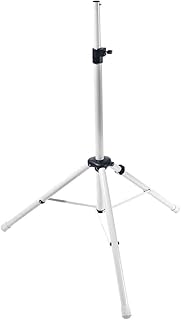
Tripod compatibility is valuable when there is no suitable wall, ceiling or metal surface. It can also provide a more repeatable lighting position when a job requires a consistent illumination angle.
Magnets can be particularly useful on suitable steel doors, scaffolding and other ferromagnetic structures. They are not a universal mounting solution, however, and should not be relied upon where the surface is unsuitable or where vibration could cause movement.
Adjustability allows the user to change the direction of illumination without moving the entire lamp. This can reduce setup time and help keep the work surface consistently illuminated as the job progresses.
Carpenters often need to inspect edges, joints, fixings and finished surfaces in workshops, kitchens, extensions and installation environments. A compact lamp can be useful when working inside cabinets or close to a workpiece, while a larger construction light can illuminate an entire installation area.
Electrical work can involve cupboards, ceiling voids, plant areas and other spaces where ambient lighting is limited. A compact, repositionable work light can be especially useful where there is insufficient space for a larger lamp.
Plumbing installations frequently take place under sinks, behind appliances, inside service cupboards and in restricted areas. Portability and the ability to redirect the lamp can be more valuable than maximum output.
Renovation projects can move from one room to another throughout the day. A cordless construction light reduces dependence on fixed power points and can provide broader illumination while walls, ceilings and floors are being worked on.
Surface visibility is important when assessing floors and preparing substrates. Controlled illumination can reveal surface irregularities that are difficult to identify under uneven ambient lighting. A dedicated inspection light may therefore be preferable when the purpose is surface assessment rather than general illumination.
Decorating work benefits from consistent illumination because shadows and changing light can make surface imperfections difficult to identify. Broad, relatively even lighting can be useful when inspecting walls and ceilings before or during finishing work.
These two categories should not be confused.
A general work light is intended primarily to help you see what you are doing. A surface inspection light has a more specialised purpose: helping reveal irregularities, imperfections and changes in surface texture.
For painting, plastering, flooring preparation and detailed finishing work, a dedicated surface-control solution may provide more useful information than simply increasing the brightness of a general floodlight.
The Festool SYSLITE DUO belongs to the large-area lighting side of the SYSLITE family. Festool describes it as a high-output working light with an 8,000-lumen output and a 180-degree scattering angle, designed to illuminate large areas with daylight-like light.
However, it is important for buyers specifically searching for Festool cordless torches and lighting to check the power arrangement of the exact DUO configuration. The fact that a product belongs to the SYSLITE family does not automatically mean it is battery powered.
This distinction matters because a large-area mains-powered light and a cordless construction light solve different problems. If portability and operation without a mains connection are essential, prioritise products whose current specifications explicitly confirm cordless battery operation.
Buyers may encounter older Festool lighting models such as the SYSLITE KAL II when comparing listings, existing equipment or older product information. Earlier Festool catalogues describe the KAL II as a compact working light capable of operating with Festool battery packs as well as other power sources.
Older product names can create confusion because specifications, packaging, battery compatibility and included accessories may differ between generations or configurations. If a retailer lists an older SYSLITE model, check the exact product number and manufacturer's documentation rather than relying on a generic product title.
This is particularly important when comparing a previous-generation KAL II with the current KAL C. A newer model should not automatically be assumed to be superior for every user, and an older model should not automatically be considered equivalent simply because both carry the SYSLITE name.
Festool is not the only professional power-tool manufacturer producing cordless work lights. Buyers may also encounter lighting products from Makita, DeWalt, Bosch Professional, Milwaukee, Metabo and HiKOKI.
The best choice depends heavily on the cordless ecosystem already used by the buyer.
Makita has a broad cordless tool ecosystem and offers a variety of portable lighting solutions. When comparing the two brands, look beyond maximum output and examine battery compatibility, mounting systems, physical dimensions and whether the light is intended for close-up, area or inspection work.
DeWalt is another major professional cordless platform with work-light options designed for construction and workshop applications. Buyers invested in DeWalt batteries may find platform compatibility more important than small differences in lighting specifications.
Bosch Professional lighting products cover several portable and jobsite applications. A useful comparison should consider the specific lighting pattern, mounting arrangement and battery platform rather than comparing brands at a general level.
Milwaukee offers a large range of cordless site and task lighting. Its products can be attractive to users already working within the M18 or other compatible cordless systems. For a fair comparison, compare like-for-like products by output, beam coverage, runtime, mounting and size.
Metabo and HiKOKI also offer professional cordless platforms with compatible lighting solutions. For tradespeople already invested in either system, battery availability and charger compatibility can make the platform decision more significant than brand reputation alone.
Use the following checklist when comparing two or more models.
More light is not always better. Excessive brightness can create glare and strong shadows in close working situations. Select the output according to the area and task.
A high-output lamp with an unsuitable beam pattern may be less useful than a lower-output model that provides better coverage of the actual work surface.
A cordless light may be easy to carry without a battery but noticeably heavier once a large-capacity pack is attached. This matters more for handheld or frequently repositioned lights than for lamps that remain stationary.
The SYSLITE family includes different types of lighting. Always confirm the power source for the exact model.
A product description may refer to the lamp body while the photographed or separately listed accessories can vary. Check whether the battery, charger, tripod, magnetic attachment or other accessories are actually included in the configuration being considered.
A product's maximum lumen figure tells only part of the story. A useful buying decision also considers runtime, positioning, protection, dimensions and the size of the work area.
There is no single lumen figure that is correct for every workshop or construction task.
Runtime is affected by output level and battery capacity. If a light has adjustable brightness, using a lower setting when maximum output is unnecessary can reduce energy consumption and extend practical operating time.
For example, Festool's published KAL C figures indicate longer maximum-output operation with a 5.0 Ah battery than with a 4.0 Ah battery. The KBS C similarly has a longer stated maximum-output runtime with a 5.0 Ah pack than with a 4.0 Ah pack.
These figures should be used when planning work rather than interpreted as guaranteed operating times under every condition. Battery age, ambient temperature, battery condition and actual brightness selection can all affect results.
Festool cordless lighting can make particular sense for professionals already using the Festool 18V ecosystem. The ability to share compatible battery packs across tools and lighting can simplify equipment management and reduce the need to maintain a separate battery platform.
The value proposition is less straightforward if you do not already own compatible Festool batteries and chargers. In that situation, compare the complete system cost rather than judging the lamp alone.
For professional users, the practical value of a work light also comes from positioning flexibility, durability, visibility and reduced setup time. For occasional DIY use, a smaller and simpler light may be sufficient unless there is a specific requirement for higher output or compatibility with an existing Festool system.
A workshop usually allows more controlled positioning. A light can remain on a bench, tripod or nearby surface for a relatively long period. Construction sites are different because the work area changes constantly and the available mounting surfaces may be unpredictable.
For workshops, beam quality, colour rendering, adjustable brightness and positioning can be particularly important. On construction sites, portability, battery runtime, impact resistance, protection against dust and moisture and quick mounting can become more significant.
Dust and debris can accumulate around the housing, controls and light-emitting area. Clean the lamp using the method recommended by the manufacturer rather than aggressive solvents or unsuitable cleaning products.
Scratches, contamination and damage to the front optical area can affect the quality of illumination. Store the light so that the lens is not repeatedly exposed to sharp objects or loose tools.
Battery contacts should remain clean and free from contamination. Avoid forcing a battery into position and investigate any unusual resistance or physical damage before continuing to use the equipment.
Hooks, magnets, tripod threads and other mounting components are important working parts. Damage to these components can result in poor positioning or an unstable lamp.
Follow Festool's instructions for battery storage, charging and operating conditions. Avoid leaving batteries in unsuitable temperatures or environments.
There is no universal best model. The Festool SYSLITE KAL C is a strong choice when compact size and close-range illumination are priorities, while the SYSLITE KBS C is more appropriate when substantially higher output and broader construction-site illumination are required.
Yes. The SYSLITE KAL C is an 18V cordless working light. Festool specifies compatibility with its 18V battery packs except Ergopack batteries.
The Festool SYSLITE KAL C has a maximum luminous flux of 1,200 lumens and three brightness levels of 300, 600 and 1,200 lumens.
The SYSLITE KBS C has a maximum luminous flux of 5,000 lumens and continuously adjustable brightness.
The KAL C specification lists a colour temperature of 5,000 K, providing a daylight-like working light.
Yes. The KAL C has a 1/4-inch stand thread and can also be positioned using its hook. Festool also lists a magnetic spherical-head accessory for additional positioning flexibility.
The KBS C has an IP54 protection rating and is designed for demanding construction-site use. Outdoor use should still follow the manufacturer's instructions and specified operating conditions rather than treating IP54 as complete waterproofing.
Yes. Festool specifies compatibility with its 18V battery packs except Ergopack batteries. Check the exact battery and product configuration before purchasing.
Not necessarily. A higher-capacity battery can provide longer operating time but may also add weight. For a compact lamp that is carried frequently, portability can be more important than maximum battery capacity.
Several SYSLITE products are designed specifically for professional workshop and construction applications. The appropriate model depends on the task, required coverage, battery requirements and environmental conditions.
Do not assume that every SYSLITE model is cordless. Check the current specification of the exact SYSLITE DUO configuration and compare its power source with your requirements before buying.
Choose a compact torch or working light when you need portable close-up illumination. Choose a construction or area light when the objective is to illuminate a wider working zone. For surface finishing and defect detection, a specialist inspection light may be more appropriate.
The best Festool cordless lighting product is the one that matches the scale and nature of the work. For a portable light that can stay in a toolbox or Systainer and be deployed whenever a dark corner needs attention, the SYSLITE KAL C is a logical category to consider. For larger construction and renovation areas where much more illumination is required, the SYSLITE KBS C offers a different approach with higher output and broader positioning options.
Do not let the maximum lumen number make the decision by itself. Look at beam distribution, brightness adjustment, battery runtime, mounting options, protection, weight and colour characteristics. A smaller light can be the better tool for detailed work, while a high-output construction light can be the better choice for establishing general illumination across a room.
If you already own Festool cordless tools, battery compatibility can be one of the strongest practical reasons to remain within the Festool lighting ecosystem. If you are starting from scratch, compare the complete cost of the light, battery and charger and consider whether another professional battery platform already fits your wider tool collection.
Before purchasing, check the exact product number, current manufacturer specification, included accessories, battery requirements and retailer listing. Product configurations can differ, and older SYSLITE models can still appear in search results or marketplace listings. A careful specification comparison is therefore more reliable than choosing solely from a product name or headline lumen figure.
Festool cordless torches and work lights are best evaluated as task-specific professional lighting tools rather than as simple brightness products. The compact SYSLITE KAL C is focused on portability and close-range work, while the SYSLITE KBS C is designed around higher-output construction illumination. Specialist SYSLITE products serve different purposes, so checking the exact power source and intended application is essential.
For the strongest buying decision, compare the complete specification: lumens, beam coverage, colour characteristics, battery compatibility, runtime, mounting flexibility, protection, size and weight. Then match those characteristics to the environment in which the light will actually be used. This approach is more useful than simply selecting the brightest model and gives professional tradespeople, serious DIY users and workshop owners a clearer way to identify the Festool cordless lighting solution that fits their work.