

♥ Wishlist
Compare 37 verified Milwaukee Cordless Reciprocating Saws products in United Kingdom. Reviews, ratings, pros, cons and buying advice updated for November 2026.
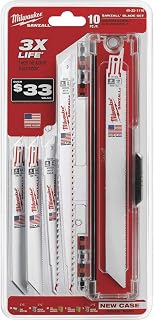


Choosing the right Milwaukee cordless reciprocating saw is less about finding the most powerful model and more about matching the saw to the type of cutting you actually do. Milwaukee's cordless range covers compact M12 models, one-handed Hackzall designs, full-size M18 SAWZALL machines and high-performance M18 FUEL models, giving buyers several distinct approaches to demolition, construction, plumbing, electrical work, renovation and general maintenance.
This guide expands the buying considerations that matter when comparing Milwaukee cordless reciprocating saws in the UK. Rather than treating every model as interchangeable, it looks at battery platform, motor technology, stroke length, cutting speed, vibration, physical size, blade-changing systems, handling, application suitability and the difference between compact and heavy-duty designs.
Milwaukee's UK reciprocating-saw range includes models such as the M12 FUEL Sub Compact HACKZALL, M18 FUEL HACKZALL, M18 FUEL SAWZALL, M18 FUEL ONE-KEY SAWZALL and M18 FUEL Super SAWZALL, alongside non-FUEL and other cordless alternatives. The important point for buyers is that these machines are designed around different use cases rather than simply being successive versions of the same tool.
A reciprocating saw uses a linear back-and-forth blade movement to cut through material. Unlike a circular saw, the blade does not rotate continuously. This makes a reciprocating saw particularly useful for rough cutting, demolition and situations where the blade needs to enter a material without creating a large opening around the cut.
The design is especially useful when precision finishing is not the primary objective. With the appropriate blade, one saw can be used for timber, timber containing nails, plastics, metal, pipework, plasterboard and other construction materials. The blade, rather than the motor alone, determines whether a particular cutting task is suitable.
This is why buying a reciprocating saw should always involve two separate decisions: choosing the machine and choosing the correct blades. A powerful saw fitted with an unsuitable blade can deliver poor results, excessive vibration and unnecessary wear, while an appropriate blade can make a substantial difference to cutting speed and control.
One of the most important distinctions in Milwaukee's cordless range is between SAWZALL and HACKZALL designs.
SAWZALL models use the familiar full-size reciprocating-saw configuration. They are generally suited to two-handed operation, heavier demolition work and applications where cutting capacity and sustained performance are more important than minimum tool size.
The full-size format provides a substantial grip and body around the reciprocating mechanism. It can be a better choice for framing, demolition, renovation, cutting larger timber and removing materials where the saw is likely to be subjected to significant loads.
HACKZALL models are designed around a more compact, one-handed format. This can make them particularly useful when access is restricted or when the user needs to position the tool quickly around pipework, fixings, branches, studs and other awkwardly positioned materials.
The smaller form factor does not automatically mean that a HACKZALL is a replacement for a full-size SAWZALL. The two designs solve different problems. A HACKZALL prioritises accessibility and manoeuvrability, while a full-size SAWZALL is generally better suited to sustained heavy cutting and larger demolition applications.
Battery voltage is one of the easiest ways to narrow the Milwaukee range, but it should not be treated as a simple measurement of cutting performance. M12 and M18 tools belong to different battery ecosystems and are built around different priorities.
The M12 platform is particularly attractive when compact dimensions, low bulk and easy portability matter. The M12 FUEL Sub Compact HACKZALL is an example of this approach. Milwaukee describes it as a compact cordless reciprocating saw designed for restricted areas, with a counterbalance mechanism intended to reduce vibration and a sealed gearbox designed to help keep water and debris out of the housing.
An M12 reciprocating saw can make sense for maintenance engineers, electricians, plumbers, installers and DIY users who frequently encounter small cutting jobs but do not want to carry a full-size demolition saw.
The M18 platform is aimed at users who need a broader range of heavy-duty cordless tools and higher-capacity battery options. M18 reciprocating saws span compact HACKZALL designs through full-size SAWZALL and Super SAWZALL models.
If you already own several M18 tools, buying an M18 reciprocating saw can also reduce the need to establish another battery platform. This is one of the strongest practical reasons to select a particular model even when another saw might appear more attractive on individual specifications.
Milwaukee's FUEL designation identifies tools that combine its POWERSTATE brushless motor, REDLITHIUM battery technology and REDLINK PLUS electronic intelligence. In a reciprocating saw, these technologies are intended to support cutting performance, efficiency, protection and durability.
The M18 FUEL SAWZALL, for example, uses a POWERSTATE brushless motor and includes features such as a gear-protecting clutch, FIXTEC blade clamp, adjustable shoe, LED work light, battery fuel gauge and reinforced battery connection.
For a buyer, the key question is not simply whether a tool carries the FUEL name. The question is whether the additional technology is useful for the work being performed frequently enough to justify choosing that model over a simpler alternative.
Brushless motors are increasingly common in professional cordless power tools because they avoid conventional motor brushes and can be electronically controlled. Milwaukee's FUEL reciprocating saws use brushless POWERSTATE motors.
For a frequent user, a brushless model can be attractive because the overall tool platform is designed around efficiency, electronic management and heavy-duty operation. For an occasional user, however, the decision should also take account of battery compatibility, purchase cost, tool size and the actual workload.
It is not necessary to choose the most advanced motor technology simply because it is available. A good buying decision considers the complete tool rather than one specification.
When comparing Milwaukee cordless reciprocating saws, several specifications deserve attention. Looking only at no-load speed can produce a misleading comparison because cutting performance depends on stroke length, blade design, material, battery condition, operator technique and the mechanical design of the saw.
Stroke length describes how far the blade travels during each reciprocating cycle. A longer stroke can move more blade through the material during each cycle and can be advantageous for aggressive cutting.
Milwaukee's range includes different stroke lengths, with full-size models extending substantially beyond the shorter travel used by compact designs. A longer stroke can be particularly useful for demolition and larger timber, but it may not always be desirable when the priority is fine positioning or restricted access.
No-load stroke rate indicates how rapidly the blade reciprocates without a cutting load. Milwaukee's cordless reciprocating saw range includes models with variable-speed operation and no-load rates reaching around 3,000 strokes per minute, depending on the specific model.
Higher speed can be useful for appropriate materials, but maximum speed should never be considered in isolation. The correct blade and controlled trigger operation are equally important.
Cutting capacity varies by model and material. Manufacturers may specify maximum cutting depths for softwood, steel, aluminium or other materials. These figures should be treated as model-specific specifications rather than universal expectations.
Before buying, identify the largest material you realistically expect to cut. A compact saw may be ideal for pipe and small timber but less appropriate when repeatedly cutting large structural timber or substantial demolition materials.
Reciprocating saws naturally generate movement because the blade travels rapidly backwards and forwards. Vibration therefore matters considerably during repeated cutting.
Milwaukee uses counterbalance mechanisms on certain models to address vibration. The M12 FUEL Sub Compact HACKZALL, for example, is specified with a counterbalance mechanism designed to reduce vibration.
Lower vibration can contribute to better handling and reduced fatigue, but the practical experience will also depend on blade selection, cutting technique, material and how long the saw is operated continuously.
Weight is not simply a disadvantage. A heavier full-size saw can feel substantial during demanding cuts, while a lighter compact model can be considerably easier to manoeuvre in confined spaces or when working overhead.
Battery choice also affects the complete working weight. A large-capacity battery may increase runtime but add bulk to a tool that is otherwise compact.
Battery capacity is normally expressed in ampere-hours, but a larger Ah figure should not automatically be interpreted as the best option for every user. Higher-capacity batteries can provide longer operating time while also increasing weight and physical size.
For a portable HACKZALL used for short cuts, a smaller battery may offer a better balance. For prolonged demolition work, a higher-capacity M18 battery may be more appropriate.
Blade changes are a routine part of using a reciprocating saw. A tool-free blade-change system can therefore have a meaningful effect on day-to-day usability.
Milwaukee uses FIXTEC blade clamps on several cordless reciprocating saws. These systems are designed to allow fast blade changes without a separate tool.
When comparing models, check exactly how the blade clamp operates and consider whether you regularly switch between wood, metal, demolition and specialist blades. A convenient clamp becomes particularly valuable when the job requires multiple blade types during the same task.
The shoe is the part of the saw that supports the tool against the workpiece while cutting. An adjustable shoe can help the user position the blade and use the available blade length more effectively.
Milwaukee includes adjustable shoes on several of its reciprocating saw models. This can be particularly useful when working with different material thicknesses or when trying to maintain a stable contact point during a cut.
Do not overlook the shoe when comparing tools. It is a small mechanical feature, but it directly influences how the saw contacts the workpiece.
The M18 FUEL SAWZALL is one of the most versatile choices in the range for users looking for a full-size cordless reciprocating saw.
Its specification includes a POWERSTATE brushless motor, gear-protecting clutch, FIXTEC blade clamp, adjustable shoe, LED light, battery fuel gauge and compatibility with Milwaukee M18 batteries.
Milwaukee states that its brushless motor provides up to 30% faster cutting and up to five times longer motor life compared with the relevant previous technology. Such manufacturer claims should be understood as product-positioning information rather than a guarantee of identical results in every material or working environment.
The M18 FUEL SAWZALL is particularly relevant to buyers who want one general-purpose full-size saw for renovation, construction, demolition and maintenance rather than a specialist compact cutting tool.
The M18 FUEL HACKZALL occupies an interesting position between compact portability and the larger M18 battery platform. Its one-handed format makes it easier to manoeuvre than a traditional full-size reciprocating saw.
This design can be useful for cutting pipe, bolts, branches, timber and other materials where access is more important than maximum full-size cutting capacity.
It is worth considering for tradespeople who already use M18 batteries but frequently find a conventional SAWZALL too large for certain tasks. The compact format can complement rather than replace a full-size reciprocating saw.
The M12 FUEL Sub Compact HACKZALL is designed for users who value compact dimensions and access. Milwaukee specifies features including a counterbalance mechanism, sealed gearbox, FIXTEC clamp, LED light and compatibility with all M12 batteries.
Its compact nature makes it particularly relevant to installation, maintenance and repair tasks where the workpiece may be positioned behind fixtures, inside service areas or in other restricted locations.
The important buying consideration is to recognise its intended role. A compact M12 saw is not necessarily the ideal substitute for a large M18 demolition saw. Instead, it can be an excellent solution when physical access and tool size are the limiting factors.
The M18 FUEL ONE-KEY SAWZALL adds connected-tool functionality to the core SAWZALL concept. Milwaukee specifies Bluetooth connectivity through the ONE-KEY app, tool customisation, tool tracking and security features, remote locking and configurable cutting functions.
The ONE-KEY version is therefore particularly relevant to professional users and organisations managing multiple power tools rather than someone who simply wants a reciprocating saw for occasional household projects.
Its customisation features can allow users to adjust aspects of tool operation for different applications. Milwaukee also specifies functions including adjustable soft start, cut optimisation, automatic brake behaviour and the ability to save custom settings.
If tool tracking and digital inventory management have little value to you, a standard M18 FUEL SAWZALL may be the more straightforward choice. If multiple tools are shared across a team, however, connected functionality can become considerably more useful.
The M18 FUEL Super SAWZALL is positioned at the heavy-duty end of Milwaukee's cordless reciprocating-saw range. Milwaukee describes it as delivering power comparable to an equivalent AC reciprocating saw and specifies a 32 mm stroke length.
The model is intended for users who regularly demand high cutting performance from a cordless machine. Milwaukee also states that the Super SAWZALL can cut 150 pieces of 290 mm by 45 mm pine on a 12.0 Ah battery charge under its stated test conditions.
Manufacturer runtime figures should always be treated as test-condition results rather than a prediction of how long a saw will run on every job. Blade type, material density, cutting pressure, battery condition and operator technique can all affect real-world runtime.
The Super SAWZALL makes the most sense when its additional capability will actually be used. For occasional small cutting jobs, its larger format may offer little practical benefit compared with a more compact model.
Demolition is one of the classic applications for a reciprocating saw. The tool can cut through timber, nails, plasterboard, pipework, fixings and other materials that make conventional saws inconvenient.
For serious demolition, a full-size M18 SAWZALL or Super SAWZALL is generally the more appropriate category to investigate. The larger format provides a stronger platform for aggressive cutting and prolonged use.
Blade selection is especially important during demolition. A blade designed for clean timber cuts is not necessarily the right choice for timber containing nails or mixed construction materials. Demolition blades are designed with different tooth configurations and construction to cope with more demanding conditions.
Plumbers often need to cut pipe, threaded components, fixings and materials in awkward positions. This makes compact reciprocating saws particularly useful.
An M18 FUEL HACKZALL can be attractive when a larger battery platform is already in use, while an M12 FUEL HACKZALL can be useful where minimum size is the priority.
For larger pipework and sustained cutting, a full-size M18 SAWZALL may provide a better overall solution. The decision should be based on the largest regular application rather than the smallest one.
Electrical installation often involves cutting cable management systems, timber, conduit, plastic, pipe and other construction materials. Restricted access is common, particularly during retrofit work.
A compact HACKZALL can therefore be more convenient than a full-size reciprocating saw when the cutting task is small and the working area is confined.
As with any electrical or construction work, the user must identify hidden services and establish that the material being cut can be safely worked on before operating the saw.
Pipe cutting requires a suitable blade, controlled tool positioning and enough access to keep the shoe stable against the workpiece. A compact one-handed saw can be advantageous when pipework is surrounded by other services.
Metal-cutting blades should be selected according to the type and thickness of the material. Using an inappropriate blade can increase heat, vibration and cutting time while reducing blade life.
For timber, the appropriate blade depends on whether the priority is speed, cleaner cutting, pruning or demolition. Coarse-tooth blades can be useful for rapid rough cutting, while finer tooth patterns are generally more appropriate when a cleaner cut is desired.
If the timber contains nails or other embedded metal, use a blade specifically intended for that type of application rather than assuming that a standard wood blade will provide the same performance.
Reciprocating saws can be used with suitable pruning blades for cutting branches and other woody material. A compact HACKZALL can be attractive for pruning because it is easier to manoeuvre than a large demolition saw.
Blade length and tooth configuration should match the branch size and species being cut. Do not treat a reciprocating saw as a direct replacement for every type of garden saw; the correct tool depends on branch size, access, control and the nature of the pruning work.
A reciprocating saw is effectively a blade-driven cutting system. The motor provides the movement, but the blade determines how that movement interacts with the material.
Wood-cutting blades are designed around tooth patterns that remove timber efficiently. Coarser teeth generally favour fast rough cutting, while finer teeth can produce a more controlled cut.
Metal-cutting blades typically use finer tooth patterns and are designed to manage the demands of steel and other metals. Blade selection should consider material thickness because tooth pitch needs to be appropriate for the section being cut.
Demolition blades are designed for mixed and demanding materials, including situations where timber and metal may be encountered together. They are particularly relevant to renovation and strip-out work.
Pruning blades are designed for green wood and branches. They should not be selected simply because they have a large tooth pattern; the blade should be appropriate for the type and size of material being cut.
A larger saw can be excellent for demolition but unnecessarily cumbersome for small maintenance jobs. If most cuts are made in confined spaces, a compact HACKZALL may be more useful day to day.
Buying a bare tool is most attractive when you already own compatible batteries. If you do not have batteries or a charger, the overall system cost can be considerably more important than the bare-tool price.
No-load speed is only one part of the equation. Stroke length, motor output, electronic control, blade choice and the material being cut all influence performance.
Even an advanced cordless saw cannot compensate fully for a blade that is unsuitable for the material. Always select a blade for the application rather than choosing one based purely on length or tooth count.
Reciprocating saws can generate substantial vibration. For users who operate the tool frequently, vibration control and ergonomic design can be more important than a small difference in headline cutting speed.
ONE-KEY provides useful functions for tool management and customisation, but not every buyer needs those features. If digital tracking and programmable settings are irrelevant to your work, compare the standard and ONE-KEY versions based on their complete specification and intended use.
Milwaukee's cordless reciprocating saws are part of its M12 and M18 battery systems. This platform compatibility is one of the most important practical considerations when selecting a model.
If you already have several M18 batteries, an M18 saw can be an efficient addition to your tool collection because the same battery ecosystem can support multiple compatible tools. The same principle applies to M12 users.
Buyers starting from scratch should compare the complete kit rather than the bare tool. A package may include one or more batteries, a charger and storage equipment, whereas a bare tool may include none of these items.
Different battery capacities provide different compromises between runtime, size and weight. A compact battery can help preserve manoeuvrability, while a larger battery can be preferable for extended cutting.
For occasional short cuts, maximum battery capacity may not be necessary. For professional demolition or prolonged cutting, investing in suitable higher-capacity M18 batteries can be more practical.
Remember that runtime is affected by the actual workload. Cutting dense timber, thick metal or mixed demolition material places a different demand on the battery from making occasional light cuts.
A bare tool is usually worth considering when you already have compatible Milwaukee batteries and a charger. This avoids unnecessarily purchasing additional battery equipment.
A kit can make more sense when entering the Milwaukee platform or when an existing battery collection does not contain a suitable capacity.
When comparing kits, check exactly what is included. Battery capacity, number of batteries, charger type, storage case and model number can all differ between packages.
Milwaukee's range includes both FUEL and non-FUEL cordless reciprocating saws. The correct choice depends on workload rather than branding alone.
FUEL models are particularly relevant to users who want brushless motor technology and the additional electronic and mechanical features associated with the platform. Standard models can still be relevant where the cutting workload is less demanding or where the buyer prioritises a simpler tool configuration.
Professional users should consider expected frequency of use, cutting intensity, battery ownership and downtime costs. Occasional DIY users may place greater emphasis on overall purchase value and whether the tool will actually be used enough to benefit from advanced features.
One-handed reciprocating saws should not be selected solely because they can be operated with one hand. The ability to use one hand is valuable because it can make positioning easier, but safe control remains essential.
A full-size SAWZALL generally provides a different handling experience, with a larger body and grip arrangement suited to two-handed use. This can be advantageous when the saw is subjected to significant cutting loads.
Think about the positions in which you normally work. A tool that feels excellent during a straightforward horizontal cut may be less convenient when reaching around pipework, working overhead or cutting in a confined service cavity.
Reciprocating saws are aggressive cutting tools and should be treated accordingly. Read the manufacturer's instructions for the specific model and use appropriate personal protective equipment for the material and working environment.
Routine maintenance helps keep a reciprocating saw ready for work. Because these tools are commonly used in dusty demolition environments, keeping the tool clean is particularly important.
Remove accumulated dust, chips and debris after use. Pay particular attention to areas around the blade clamp, shoe, vents and moving components.
Check the blade-clamping mechanism regularly. If the blade does not seat correctly, stop using the tool until the cause has been identified and resolved.
Damaged, excessively worn or inappropriate blades can increase the load placed on the tool. Replacing blades at the appropriate point is part of normal reciprocating-saw maintenance.
Keep batteries clean and store them according to Milwaukee's instructions. Avoid exposing battery packs to unsuitable temperatures, moisture or physical damage.
Check for obvious damage to the adjustable shoe, housing, grips and other external components. Heavy demolition work can subject a reciprocating saw to considerable mechanical stress.
Good reciprocating-saw performance comes from matching the blade, speed and cutting technique to the material.
Allow the blade to do the cutting instead of applying excessive force. Heavy pressure can increase vibration and make it harder for the teeth to remove material efficiently.
Keep the shoe positioned securely against the workpiece when the application permits. This can improve control and reduce unnecessary movement.
Use the variable-speed trigger appropriately. A slower controlled start can help position the blade, while higher speed can be useful once the blade is established in the cut and the material is appropriate.
Tooth count and tooth geometry affect how a reciprocating blade interacts with material. Coarse teeth can remove material rapidly and are commonly associated with timber and demolition work. Finer teeth can be more suitable for metal and applications where a more controlled cutting action is required.
The blade should also have enough teeth engaged with the material during the cut. Selecting a blade solely because it is longer or has a higher advertised tooth count can result in a poor match for the application.
Longer blades can provide greater reach and can be useful when cutting large or awkward workpieces. However, excessive blade length can also increase movement outside the workpiece and make control more difficult.
Choose a blade that provides enough usable cutting length for the material without adding unnecessary flex or exposed blade length.
Milwaukee is not the only manufacturer producing professional cordless reciprocating saws. Buyers may also compare products from Makita, DeWalt, Bosch Professional and other established power-tool brands.
The most useful comparison is not simply brand against brand. Compare the specific models on battery ecosystem, motor technology, stroke length, cutting speed, vibration, weight, blade system, warranty terms supplied by the relevant retailer or manufacturer, available accessories and the type of work you expect to perform.
For an existing tool owner, battery compatibility can be decisive. Someone already invested in M18 batteries has a different purchasing equation from someone building a new cordless platform from scratch.
Makita has a broad cordless reciprocating-saw range spanning compact and full-size machines. A meaningful comparison should focus on individual models rather than assuming that one manufacturer is universally superior.
Compare battery platforms, stroke characteristics, tool weight, ergonomics, blade changes and the manufacturer's stated cutting capacities. If you already own several Makita batteries, staying within that platform may be more practical; the same logic applies to Milwaukee M12 and M18 users.
DeWalt also offers cordless reciprocating saws aimed at professional and DIY applications. When comparing DeWalt with Milwaukee, look at the exact saw rather than comparing brands by reputation alone.
Pay particular attention to battery compatibility, overall tool balance, cutting specifications, vibration characteristics, blade-change systems and the range of compatible tools available within the battery platform you intend to use.
Bosch Professional is another established cordless power-tool platform with reciprocating-saw options. Bosch, Milwaukee, Makita and DeWalt all have different battery ecosystems, so the best choice for an individual buyer can depend heavily on the tools and batteries already owned.
For a new buyer, compare complete systems rather than isolated saw specifications. A reciprocating saw is only one part of a cordless tool collection.
A professional tradesperson may use a reciprocating saw every week or even every day, making durability, vibration, battery efficiency and ergonomics important long-term considerations.
A DIY user may only use the tool for occasional renovation, garden maintenance or demolition. In that situation, buying the most advanced model may not provide the best overall value.
The best model is therefore the one whose capabilities match the workload without adding features, weight or system cost that provide little practical benefit.
For demanding professional cutting, the full-size M18 FUEL SAWZALL and M18 FUEL Super SAWZALL deserve particular attention. The Super SAWZALL is positioned at the higher-performance end, while the standard M18 FUEL SAWZALL offers a versatile balance for general professional use.
The right choice depends on how aggressively and how frequently you cut. A heavy-duty saw is most useful when the work actually demands its additional capability.
For restricted access, the HACKZALL format is generally the more relevant category. The M12 FUEL Sub Compact HACKZALL prioritises compactness, while the M18 FUEL HACKZALL combines the one-handed format with the M18 battery platform.
Consider where the saw will physically fit before comparing maximum cutting figures. A slightly less powerful saw that can be positioned correctly may outperform a larger saw that cannot be brought comfortably into the cutting area.
For general renovation, the M18 FUEL SAWZALL is a logical model to investigate because it combines a full-size format with brushless FUEL technology and features designed for repeated cutting.
However, the best choice can change if most renovation tasks involve small pipework, confined cuts or overhead access. In those circumstances, an M18 or M12 HACKZALL may be more convenient.
Occasional DIY users should resist the assumption that the most expensive or highest-performance model is automatically the best purchase.
Start by identifying the jobs the saw will actually perform. If the main tasks are dismantling timber, cutting old fixtures and occasional garden work, a compact model or standard cordless reciprocating saw may be sufficient.
If you are already invested in Milwaukee batteries, platform compatibility can make a higher-specification model more attractive because the batteries can be shared with other tools.
Milwaukee model names can look complicated because the range contains platform, technology, tool-format and kit identifiers. Understanding the basic structure makes comparisons easier.
Names such as M12 CHZ identify an M12 reciprocating-saw platform, while M18 FSZ identifies an M18 FUEL SAWZALL family. M18 FHZ refers to the M18 FUEL HACKZALL family, while M18 FSX identifies the M18 FUEL Super SAWZALL.
Additional characters and numbers in the full model reference can indicate kit configurations, batteries, chargers and packaging. Always use the complete product code when comparing retailer listings because visually similar listings may contain different combinations of accessories.
Power-tool listings can differ by kit configuration even when the underlying tool has the same basic model designation. One listing may be bare tool only, another may include a battery and charger, and another may contain multiple batteries or a different storage solution.
Before making a purchase, compare the exact model number, included accessories, battery capacity, charger, packaging and current retailer terms. Do not assume that two listings with similar photographs contain identical contents.
Battery selection should follow the workload. Compact batteries can be advantageous when tool handling is the priority. Higher-capacity batteries can be more suitable for prolonged heavy cutting.
For a HACKZALL used in restricted spaces, excessive battery size may compromise some of the compactness that makes the tool attractive. For a full-size Super SAWZALL used for demanding demolition, higher-capacity M18 batteries can be more appropriate.
Cordless reciprocating saws provide freedom from mains cables and can be particularly convenient on construction sites, in gardens, in vehicles, during outdoor maintenance and in unfinished buildings without convenient power access.
They are also useful when the user needs to move repeatedly between cutting locations. There is no mains cable to position around the work area, although battery charging and battery availability become part of the workflow.
A corded saw can remain attractive when the tool is used continuously in a workshop or other environment where mains power is readily available. There is no need to stop for battery changes, and the complete system can be simpler for stationary work.
The choice is therefore not automatically cordless versus corded. Consider where the saw is used, how long it runs, how mobile the user needs to be and whether compatible batteries are already available.
There is no single best model for every buyer. The M18 FUEL SAWZALL is a versatile full-size option, the M18 FUEL Super SAWZALL is aimed at demanding high-performance cutting, and HACKZALL models are better suited to users who prioritise compact one-handed operation.
It can be a strong choice for users who need a full-size cordless reciprocating saw and already use the M18 battery platform. Its brushless FUEL system, FIXTEC blade clamp, adjustable shoe, LED and protective mechanical features make it a comprehensive professional-oriented tool.
The main difference is the physical format and intended use. The SAWZALL is a full-size reciprocating saw designed around heavy-duty cutting, while the HACKZALL uses a compact one-handed design intended for manoeuvrability and restricted access.
The M12 FUEL Sub Compact HACKZALL can be an appropriate choice for compact cutting tasks, particularly where access and tool size matter. It should not automatically be expected to match a full-size M18 SAWZALL for every heavy-duty application.
Yes, a compatible reciprocating-saw blade can be used for metal cutting, provided the blade and tool are appropriate for the material. Blade selection should account for metal type and thickness.
Yes. With an appropriate wood-cutting blade, Milwaukee reciprocating saws can be used for timber, construction wood and suitable pruning applications. The correct blade depends on the material and desired cutting characteristics.
Suitable demolition or wood-and-metal blades can be used for applications where timber contains nails. Always select a blade specifically intended for the material combination rather than relying on a standard wood blade.
Milwaukee reciprocating saws use reciprocating-saw blades, and the blade should be selected according to the material. Wood, metal, demolition and pruning applications can require different tooth designs and blade constructions.
FUEL identifies Milwaukee's combination of POWERSTATE brushless motor technology, REDLITHIUM battery technology and REDLINK PLUS electronic intelligence. The precise features vary by tool.
ONE-KEY adds connected functionality such as Bluetooth connectivity, tool customisation, tracking and security features. On the M18 FUEL ONE-KEY SAWZALL, Milwaukee also specifies configurable cutting functions and saved tool settings.
Not automatically. M18 models generally provide a broader range of full-size and heavy-duty options, while M12 models prioritise compactness and portability. The better platform depends on your workload and existing batteries.
Neither design is universally better. A HACKZALL is preferable when compactness and one-handed access matter, while a SAWZALL is generally more appropriate for heavy-duty full-size cutting.
For demanding demolition, investigate the full-size M18 FUEL SAWZALL and M18 FUEL Super SAWZALL. The best choice depends on the material sizes, cutting frequency, required portability and battery setup.
A HACKZALL can be particularly useful for plumbing because its compact format can make pipe and fixture cutting easier in restricted areas. For larger or sustained cutting, an M18 full-size SAWZALL may be more appropriate.
Compact HACKZALL models are worth considering for electricians who regularly work in confined areas. An M12 FUEL model is particularly compact, while the M18 FUEL HACKZALL provides access to the larger M18 battery platform.
A compact HACKZALL fitted with a suitable pruning blade can be convenient for branch cutting. Select the blade according to branch size and wood type, and use the tool only where the application and working position are safe.
Milwaukee cordless reciprocating saws include models with variable-speed operation. Variable speed is useful because different materials and cutting stages can benefit from different operating speeds.
Several Milwaukee cordless reciprocating saws include integrated LED lighting intended to illuminate the cutting area. Check the specification of the exact model because features vary across the range.
Several models use Milwaukee's FIXTEC blade-clamping system, which is designed for fast, tool-free blade changes. Always verify the exact specification for the model being considered.
A bare tool can be a sensible choice if you already own compatible M12 or M18 batteries and a charger. If you are new to the platform, compare the complete kit cost and included equipment before choosing.
There is no single runtime figure that applies to every job. Runtime depends on battery capacity, material, blade, cutting pressure, temperature, tool model and workload. Manufacturer runtime figures should be interpreted according to their stated test conditions.
Milwaukee offers cordless reciprocating saws specifically aimed at demanding professional applications, including M18 FUEL and Super SAWZALL models. The appropriate choice depends on the trade, cutting workload and required tool format.
The best Milwaukee cordless reciprocating saw is the one that fits the way you work. There is little benefit in carrying a large Super SAWZALL into a confined service area when a compact HACKZALL would be easier to position. Equally, a small M12 saw may not be the sensible primary tool for a professional demolition contractor who regularly cuts large timber and mixed construction materials.
For many professional users, the M18 FUEL SAWZALL represents a useful middle ground between portability, full-size cutting capability and advanced cordless technology. The M18 FUEL HACKZALL and M12 FUEL Sub Compact HACKZALL make more sense when access and manoeuvrability are the main priorities, while the M18 FUEL ONE-KEY SAWZALL is particularly relevant when connected tool management is valuable. At the high-performance end, the M18 FUEL Super SAWZALL is aimed at users who can genuinely take advantage of its heavy-duty cutting capability.
Before buying, compare the exact model, battery platform, kit contents, stroke specifications, cutting capacity, vibration features, blade system and intended application. Most importantly, compare the saw with the work you actually do rather than choosing solely on headline power or price.
Product specifications, model configurations, battery kits and retailer availability can change over time. For a purchase in 2026, check the current manufacturer specification and the exact retailer listing before making a final decision.