

♥ Wishlist
Compare 55 verified Scale Rulers for Accurate Technical and Architectural Drawings products in United Kingdom. Reviews, ratings, pros, cons and buying advice updated for October 2026.
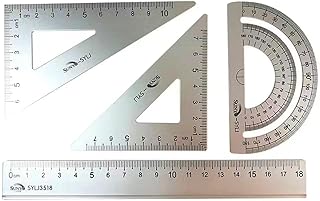


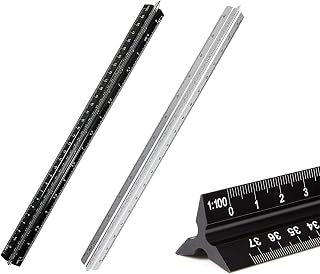


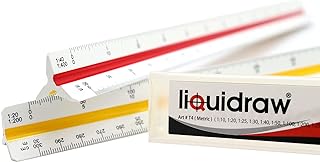


A scale ruler is a specialist measuring and drawing tool designed to represent real-world dimensions at a reduced or enlarged scale. Unlike a conventional ruler, which normally shows measurements at full size, a scale ruler allows architects, engineers, designers, students, model makers and technical drawing users to read scaled dimensions directly from plans, drawings and models.
Choosing the right scale ruler is not simply a matter of selecting the longest or cheapest option. The scale ratios, graduations, blade profile, material, accuracy, readability and intended application can all affect how useful the ruler is in practice. A triangular architect's scale, flat engineer's scale, stainless-steel ruler and compact pocket scale may all perform well, but they are designed around different working requirements.
This guide explains what to look for when comparing the best scale ruler products in the UK, how common scales work, which materials are worth considering, how to avoid measurement mistakes and which features matter for professional, educational and hobby use.
A scale ruler is a measuring instrument with calibrated graduations corresponding to a particular drawing or model scale. It is commonly used where a drawing represents an object, building, site or component at a smaller scale than its actual dimensions.
For example, a drawing may use a scale of 1:100, meaning that one unit measured on the drawing represents 100 of the same units in reality. A suitably marked scale ruler lets the user interpret that drawing without repeatedly performing manual calculations.
Scale rulers are particularly useful for:
The basic principle is straightforward: the ruler is calibrated so that a distance measured along a particular scale represents a larger real-world distance. The important point is that the markings must match the scale used on the drawing.
Consider a 1:50 architectural drawing. A measurement taken using the corresponding 1:50 edge is interpreted as a real-world dimension according to that ratio. The user therefore does not need to multiply every measurement manually.
Common scale relationships include 1:20, 1:25, 1:50, 1:100 and 1:200. More specialised rulers may include additional ratios. Before buying, check the exact scales you regularly encounter rather than assuming that every scale ruler provides the same graduations.
A standard ruler is intended primarily for direct measurement. A 30 cm ruler, for example, normally represents a physical length of 30 cm. A scale ruler is different because its graduations are intended to correspond to a drawing scale.
A conventional ruler can still be useful alongside a scale ruler. In many workflows, the ordinary ruler handles direct measurements while the scale ruler is reserved for plans, diagrams and technical drawings.
The most important specification is the collection of scale ratios printed on the ruler. A tool that looks impressive but lacks the scale you actually use is of limited value.
Before comparing products, review your drawings and identify the scales that appear most frequently. Architects may prioritise architectural ratios, while engineers and technical drawing students may need a different combination of metric scales.
Metric scales are particularly important for UK users working with modern architectural, construction, educational and engineering documentation. Clear millimetre and centimetre graduations can make detailed work easier, particularly when measurements are small.
Look for consistently printed markings with sufficient contrast and spacing to distinguish major and minor graduations. Very dense markings can be difficult to read quickly, especially when working with detailed drawings.
Scale rulers are commonly manufactured from plastic, aluminium or stainless steel. Each material has different strengths.
Material alone does not guarantee accuracy. The quality of the graduations, manufacturing tolerances and overall construction also matter.
Clear graduations are essential. If the markings are faint, crowded or difficult to distinguish, even an otherwise well-made scale ruler can slow down technical work.
When comparing products, pay attention to the size of the printed numbers, the distinction between major and minor divisions, and whether the scale labels are easy to identify without turning the ruler repeatedly.
The measuring edge should be straight, stable and easy to position against the line being measured. Some scale rulers incorporate a raised or bevelled edge that helps reduce contact between the printed markings and the drawing surface.
A clean edge can also help when the ruler is being used for drawing lines rather than simply reading dimensions.
The appropriate ruler length depends on the drawings you work with. Longer rulers can make it easier to work across larger plans, whereas compact rulers are easier to store and carry.
A 15 cm or similarly compact scale may be convenient for students and portable drafting work. Longer options can be more practical for large-format architectural or engineering drawings. Do not choose length in isolation; a longer ruler is not automatically more useful if the required scales are missing.
Triangular scale rulers are among the most recognisable tools used for architectural and technical drawing. Their three-sided construction allows multiple calibrated edges to be incorporated into one tool.
This format can be particularly convenient when several scales are required during the same project. Instead of carrying several separate rulers, the user can rotate the triangular tool to access another scale.
Flat scale rulers resemble conventional rulers but include specialised scale graduations. They are often convenient for users who prefer a simple, slim measuring tool.
A flat design can be particularly useful for carrying inside a drawing folder, notebook or tool case. It may also be easier to position alongside straight edges and other drafting equipment.
When comparing flat models, inspect the number of available scales, the readability of the graduations and whether the ruler provides a durable working edge.
An architect's scale ruler is intended primarily for architectural drawings, floor plans, elevations and related design documents. Architectural scales are used to represent buildings and spaces at manageable drawing sizes while retaining useful dimensional relationships.
When selecting an architectural scale, consider the drawing formats you normally encounter. A student working on floor plans may require a different set of scales from a professional producing detailed construction drawings.
Common architectural scale requirements can include ratios such as 1:20, 1:50, 1:100 and 1:200, although the appropriate selection depends on the specific project and drawing convention.
Engineer scale rulers are designed for technical drawings where measurements may represent larger physical distances. They are useful for engineering plans, diagrams and certain construction-related applications.
Do not assume an engineer scale and an architectural scale are interchangeable. Although they may look similar, their graduations and intended measurement conventions can differ. Always match the ruler to the scale printed on the drawing.
Metric measurement is central to many modern UK technical and construction environments. A metric scale ruler can therefore be a practical choice for users who routinely work with millimetres, centimetres and metres.
When choosing a metric scale ruler, check whether the scale ratios are explicitly marked and whether the graduations are sufficiently precise for your work. For detailed technical drawings, fine graduations and clear numbering can be more important than additional decorative features.
Plastic models are often suitable for students, home users and occasional drafting tasks. They are lightweight and generally easy to carry.
Transparent plastic can offer an additional advantage because the drawing remains visible beneath the ruler. This can make it easier to align the edge with a line or locate a specific point on a plan.
The main consideration is long-term durability. A plastic ruler can be affected by bending, impact, heat or careless storage, depending on the material and construction.
Aluminium provides a useful balance between rigidity and portability. It can be a sensible choice for frequent users who want a more robust tool without the weight associated with some heavier metal designs.
Look for a straight, well-finished edge and clearly marked scales. A strong body is beneficial, but inaccurate or poorly printed graduations can still compromise the usefulness of the ruler.
Stainless-steel rulers are suited to users who prioritise durability and resistance to everyday wear. They can be useful in professional workshops, technical environments and situations where a ruler is likely to be handled frequently.
Metal rulers can also provide a firm straight edge for drawing and marking. However, they may be heavier than plastic alternatives and can be less convenient when portability is the main priority.
Transparency can be particularly valuable when measuring directly over detailed drawings. Being able to see the line beneath the ruler makes alignment easier and can reduce the need to repeatedly lift and reposition the tool.
For architectural plans containing walls, dimensions, symbols and overlapping annotations, a transparent ruler can provide useful visual control. However, the markings must remain sufficiently visible against the drawing for the transparency to provide a practical benefit.
The best scale ruler depends on the work rather than a universal ranking. Use the following process when comparing options.
Students often need a scale ruler for architectural technology, engineering, design, construction or technical drawing coursework. In this situation, simplicity and readability can be more useful than an expensive professional-grade tool.
Look for a ruler that includes the scales required by your course, has clearly printed graduations and is easy to carry between home, college and university. A transparent plastic model can be useful for learning because it makes alignment easier to see.
Before purchasing, check your course materials or assignment requirements. Buying a ruler with the wrong scales is a common mistake and can lead to unnecessary replacement.
Architectural users often move between different drawing scales depending on the stage of a project. Early layouts may use relatively small scales to show an entire building or site, while detailed drawings require larger scales to represent construction elements more precisely.
A multi-scale triangular ruler can therefore be convenient for professional workflows. Prioritise clear scale identification, durable construction and an edge that remains straight through regular use.
Architects and architectural students should also consider whether the ruler will be used mainly for reading dimensions, drawing straight lines or both. A ruler that performs well in both roles can reduce the need for additional drafting equipment.
Engineering drawings demand careful measurement and consistent interpretation. A scale ruler should therefore be selected according to the engineering discipline and drawing conventions involved.
Mechanical engineering, civil engineering, electrical layouts and construction documentation can involve different drawing requirements. Always confirm the required scales rather than selecting a ruler solely because its product description contains the word “engineering”.
For workshop environments, a durable metal ruler may be preferable where the tool will be exposed to frequent handling. For classroom or office use, a lightweight transparent ruler may be more convenient.
Model makers use scale relationships to reproduce buildings, vehicles, structures, furniture and other objects at reduced dimensions. Here, the relevant scale can be very different from those commonly used for architectural plans.
Accuracy and fine graduations become especially important when working with small components. A compact ruler with clearly defined divisions may be more practical than a large general-purpose architectural scale.
Before buying, establish the model's scale and choose a ruler that directly supports it. If several scales are used across different projects, a multi-scale ruler can reduce the number of tools required.
This is one of the easiest errors to make. A triangular ruler may contain several scales that look similar at first glance. Always identify the correct scale before taking a measurement.
Scale graduations can differ from conventional ruler markings. Starting from the wrong end can produce an incorrect reading even when the correct scale edge has been selected.
Different products may include different combinations of architectural, engineering and metric scales. Never assume that a familiar-looking ruler has the scales required for your drawings.
The scale printed in the drawing, title block or project documentation should always take priority. Do not guess the scale from the apparent size of the drawing.
A chipped, bent or warped ruler can make alignment difficult. Inspect the working edge regularly, particularly if the tool is used for technical drawing.
Printed drawings may sometimes be resized during copying or digital printing. If a drawing has been enlarged or reduced, its original stated scale may no longer correspond to the physical dimensions on the paper.
Product photographs can make scale rulers look broadly similar, so inspect the specification details carefully.
Accuracy is particularly important in technical drawing, but buyers should distinguish between the accuracy of the ruler and the precision of the drawing itself.
A finely graduated ruler can allow more precise readings, but the final measurement can still be affected by paper distortion, printing scale, line thickness, viewing angle and alignment. For that reason, a professional-looking ruler should always be used alongside good measurement practice.
For critical engineering or construction decisions, measurements should be verified against the appropriate project documentation and professional procedures rather than relying solely on a consumer drafting tool.
A scale ruler can only provide a meaningful direct reading when the drawing has been produced at the intended scale. Paper can expand or contract with environmental conditions, while digital printers and photocopiers can introduce scaling changes.
For important plans, verify that the drawing has been printed at its intended size. A graphical scale bar, when provided, can also help determine whether a printed drawing has been resized.
Start by locating the scale specified on the drawing. Find the corresponding edge or graduation on the ruler and align the ruler carefully with the feature being measured.
Keep the ruler flat against the drawing where practical and read the dimension directly from the appropriate scale. Avoid switching between scale edges during a single measurement unless you have a clear reason to do so.
When accuracy matters, repeat the measurement and check that the result makes sense relative to nearby dimensions. Unexpectedly large or small values can be an indication that the wrong scale was selected.
Good maintenance can help preserve both the physical condition of the ruler and the readability of its markings.
When comparing several scale rulers, it helps to rank features according to your actual use rather than treating every specification equally.
Several established stationery, drafting and measuring-tool brands may appear when comparing scale rulers and related technical drawing equipment. Examples include Staedtler, Rotring, Faber-Castell, Westcott, Maped and Helix.
Brand recognition can be useful when narrowing a shortlist, but it should not replace checking the actual specifications. A well-known manufacturer can produce multiple ruler formats aimed at different applications, and the most suitable choice depends on the scale ratios, material and dimensions you require.
The appropriate budget depends on frequency of use and the level of durability required. Occasional users may have little reason to pay for premium construction when a simple ruler meets their needs. Professionals who use a scale ruler every day may benefit more from investing in robust construction and clear, durable graduations.
Rather than selecting a product purely on price, compare the cost against the features you will genuinely use. A low-cost ruler with the wrong scales is poor value, while a premium multi-scale ruler may be unnecessary for someone who only needs one ratio.
A higher-specification model may be worth considering when the ruler is used frequently, carried between work locations or subjected to repeated handling. Durable materials, precise manufacturing and clear markings can become more valuable over time.
However, premium construction should not be confused with suitability. If the ruler does not contain the scales needed for your drawings, additional durability will not solve the fundamental problem.
Use this checklist before making a final purchasing decision:
The best scale ruler is the one that provides the correct scales, clear graduations, suitable dimensions and appropriate construction for your work. An architect may prefer a multi-scale triangular ruler, while a student or hobbyist may find a lightweight flat metric ruler more convenient.
Architects commonly use architectural scale rulers that provide ratios suitable for building plans, elevations and detailed drawings. The exact scales required depend on the type and stage of the project.
A properly manufactured scale ruler is designed to provide calibrated measurements, but the reliability of the final reading also depends on correct scale selection, alignment and the condition and printing of the drawing.
They are designed around different measurement conventions and scale arrangements. An architectural scale is generally intended for architectural drawings, whereas an engineer scale is designed for engineering and technical applications. Always use the scale specified by the drawing.
A triangular scale ruler can be better when you regularly need several scale ratios because multiple calibrated edges can be combined in one tool. It is not automatically better for every user, particularly if you only need one or two scales.
Stainless steel generally offers greater rigidity and durability, while plastic can provide lower weight and, in transparent designs, improved visibility of the drawing underneath. The better material depends on how and where the ruler will be used.
Yes. Metric scale rulers are widely relevant to UK architectural, engineering, construction, educational and technical drawing applications. Check the required scale ratios before buying.
You can measure the physical distance on a drawing with a normal ruler and then calculate the real-world dimension manually. A scale ruler is more convenient when you regularly work with scaled drawings because the appropriate graduations simplify direct reading.
The appropriate scales depend on your drawings, but common architectural applications can involve ratios such as 1:20, 1:50, 1:100 and 1:200. Confirm the scales used in your projects before choosing a ruler.
Yes. Scale rulers can be particularly useful for model making because they allow dimensions to be interpreted according to the model's scale. Choose a ruler that includes the exact ratio used by the model.
There is no single best material for every professional. Stainless steel and aluminium can provide strong, rigid construction, while high-quality plastic can be lightweight and easier to see through. The best choice depends on the working environment and required portability.
Identify the scale ratio specified on the drawing and then locate the corresponding scale marking on the ruler. Do not select an edge simply because its graduations look familiar.
Yes. Digital resizing, photocopying and incorrect printer settings can change the physical size of a drawing. If the scale is important, verify that the drawing has been printed at the intended scale before relying on direct measurements.
Choosing a scale ruler should begin with the drawings you need to interpret, not with the appearance of the ruler. Identify the required scale ratios first, then compare graduation clarity, material, length, edge design, portability and overall construction.
For architectural work, a multi-scale triangular ruler can be highly practical. For straightforward technical drawing, a flat metric scale may be easier to handle. Students often benefit from a lightweight and readable design, while frequent professional users may prefer a more durable aluminium or stainless-steel construction.
Before buying, compare the full specifications, check verified customer feedback and make sure the product contains the exact scales you need. Also consider the quality of the drawings you will be measuring, because even an accurate ruler cannot compensate for a plan that has been incorrectly resized or printed.
The most useful scale ruler is ultimately the one that fits your workflow: the right scales, readable markings, dependable edge and suitable material can make technical measurement faster, clearer and less prone to avoidable errors.