
♥ Wishlist
Compare 14 verified Cordless Cut Off Saws products in United Kingdom. Reviews, ratings, pros, cons and buying advice updated for October 2026.


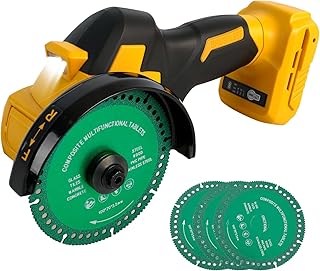



Choosing a cordless cut-off saw is less about finding the tool with the biggest battery or highest claimed power and more about matching the saw to the material, cutting depth, disc size, working environment and frequency of use. A compact battery-powered cut-off saw can be extremely useful for construction, renovation, landscaping, metalwork and general site work, particularly where mains electricity is inconvenient or where a trailing cable would restrict movement.
The most suitable model depends heavily on what you intend to cut. Concrete, masonry, paving slabs, engineering brick, metal, plastic and other materials place very different demands on a saw and its abrasive or diamond cutting disc. Battery platform compatibility can also be important because a cordless saw becomes considerably more practical when its batteries and charger can be shared with drills, grinders, impact drivers, saws and other tools already in your workshop.
This expanded guide focuses on the specifications and practical considerations that matter when comparing cordless cut-off saws in the UK. It also explains disc selection, battery systems, cutting depth, dust management, water supply, ergonomics, maintenance, safety and common purchasing mistakes so you can compare products on useful criteria rather than headline specifications alone.
A cordless cut-off saw is a portable cutting machine powered by a rechargeable battery rather than a mains electrical supply or petrol engine. It normally uses a rotating abrasive or diamond blade to cut materials such as masonry, concrete, paving, metal and other suitable workpieces.
Although cordless cut-off saws can resemble angle grinders or compact circular saws, they are designed around a different type of cutting operation. A dedicated cut-off saw generally provides a larger cutting disc, a more substantial guard and a configuration intended for making relatively deep straight cuts. Depending on the model, it may also incorporate a water-feed connection for dust suppression when cutting suitable masonry and mineral materials.
Popular professional cordless tool ecosystems from manufacturers such as DeWalt, Makita, Milwaukee, Bosch Professional, HiKOKI and other established tool brands include battery-powered cutting equipment. Exact specifications differ considerably between models, so the brand alone should never be treated as a substitute for checking the individual machine's technical information.
The best cordless cut-off saw for your work should provide enough cutting capacity and sustained performance for the materials you regularly handle while remaining manageable during repeated cuts. For most buyers, the most important characteristics are disc compatibility, maximum cutting depth, battery voltage and platform, motor performance, weight, guard design, dust or water-management options and the availability of suitable replacement discs.
One of the most common buying questions is whether a cordless cut-off saw is necessary when you already own a battery-powered angle grinder. The answer depends on the type and depth of cutting you need to perform.
An angle grinder is exceptionally versatile. With the appropriate disc, it can grind, deburr, polish and make relatively shallow cuts in suitable materials. Its compact format makes it useful for fabrication and general maintenance.
A dedicated cut-off saw is more specialised. Its configuration is intended primarily for cutting, and models designed for masonry applications can offer substantially greater cutting capacity than a typical compact grinder. A dedicated saw may also provide features specifically intended for controlling dust or supplying water to the cutting area.
The fundamental advantage of cordless equipment is freedom from the mains cable. On construction sites, outside areas, unfinished buildings and locations where power is unavailable or inconvenient, that freedom can save time and simplify positioning.
A corded machine, however, can provide continuous operation as long as an appropriate electrical supply is available. There is no battery charging cycle and no need to carry additional battery packs.
When comparing the two, do not compare only the saw itself. Consider the complete working system, including batteries, charger, extension leads where applicable, dust extraction, water supply and replacement accessories.
Petrol cut-off saws have traditionally been associated with demanding outdoor cutting because they can operate without mains electricity and can deliver substantial cutting performance. Modern professional cordless systems have introduced a different approach, particularly for applications where reduced local emissions, lower routine noise and easier starting are desirable.
A battery-powered machine can be particularly convenient for indoor renovation or enclosed construction environments where petrol exhaust would be inappropriate. However, cordless equipment still depends on battery capacity, battery temperature, charging logistics and the particular machine's design.
If comparing cordless and petrol machines, evaluate the complete application rather than assuming that one power source is automatically superior. The right choice depends on cutting depth, duty cycle, portability, ventilation, operating environment and access to batteries or fuel.
Disc diameter is one of the most important specifications on a cut-off saw because it influences the maximum cutting depth and the accessories that can be used.
A larger disc can generally provide greater potential cutting depth, although the actual capacity depends on the saw's design, guard arrangement, spindle position and manufacturer's stated specification.
Never select a replacement disc simply because it physically appears to fit. The disc must be compatible with the machine's specified diameter, bore, maximum permitted speed and intended application.
Cordless cut-off equipment is available in several sizes, with compact models intended for portability and larger professional machines designed for deeper cutting. The exact disc diameter varies between manufacturers and models.
Rather than selecting the largest disc available, determine the deepest cut you actually need. Oversizing the machine can make it heavier and less comfortable without providing a practical advantage for your work.
Maximum cutting depth tells you how deeply the saw can cut under the manufacturer's specified conditions. It is one of the most useful specifications for comparing models.
Do not confuse disc diameter with cutting depth. Two saws using similarly sized discs can have different cutting capacities because of differences in guard design, spindle geometry and machine construction.
When comparing products, ask yourself:
A model with slightly greater capacity than your normal requirement can provide useful headroom, but buying substantially more capacity than necessary may add weight and cost without improving everyday productivity.
Battery voltage is an important specification, but it should not be interpreted as a simple measurement of overall cutting performance. Modern cordless tool systems use different battery technologies, electronic controls and motor designs, so two machines with similar nominal voltage can behave differently.
Battery voltage should therefore be considered alongside motor design, battery capacity, electronics, disc diameter, cutting application and the manufacturer's intended use.
Battery capacity is commonly expressed in amp-hours, abbreviated as Ah. In broad terms, a higher-capacity battery can provide more stored electrical energy, although actual runtime depends heavily on workload and the machine's power demand.
Cutting dense masonry or concrete can place a much greater load on a battery than light-duty cutting. Consequently, advertised or theoretical runtime figures should not be treated as a guaranteed number of cuts for every material.
For many buyers, battery compatibility is one of the strongest reasons to choose one cordless cut-off saw over another. If you already own several tools from the same battery platform, adding a compatible saw can be more economical and convenient than starting an entirely new system.
Brands including DeWalt, Makita, Milwaukee, Bosch Professional and HiKOKI operate established cordless ecosystems, but battery compatibility is not universal between brands and can also vary within product families.
Always verify the exact battery system supported by the specific saw. Do not assume that two tools from the same manufacturer necessarily share every battery generation or voltage class.
Brushless motor technology is widely used in modern professional cordless tools. A brushless design removes conventional carbon brushes and uses electronic control to operate the motor.
For a cut-off saw, this can contribute to an efficient cordless system and reduce one category of routine wear associated with brushed motors. However, brushless does not automatically mean that a particular saw is the best choice. Overall performance still depends on the motor, electronics, battery, gearing, cooling, blade and machine design.
When comparing brushless models, focus on the complete specification rather than treating the brushless label as a performance guarantee.
The disc is just as important as the saw. Using an unsuitable cutting disc can produce poor results, excessive wear and potentially dangerous operating conditions.
Diamond cutting discs are commonly used for mineral materials such as concrete, masonry, brick, stone and paving products where the particular disc is rated for the intended material.
Diamond blades are available in different segment and rim configurations. The correct choice depends on the material and cutting method.
Always follow the disc manufacturer's compatibility instructions. A blade designed for one material should not automatically be assumed suitable for another.
Metal-cutting applications generally use abrasive cutting discs specifically rated for the material and machine. Different metals can behave differently during cutting, so disc selection matters.
Check the disc's intended material, maximum rotational speed and dimensional requirements before fitting it to the saw.
Water can be used with suitable masonry-cutting equipment to suppress airborne dust and cool the cutting area. Some cordless cut-off saws provide a water-feed connection or integrated water-management feature for compatible applications.
Wet cutting can be useful when working with mineral materials, but it is not appropriate for every machine, disc or environment. Electrical safety requirements, the saw's manufacturer's instructions and the disc manufacturer's instructions must all be followed.
Dry cutting avoids the need for a water supply but may require particularly careful dust management. Cutting mineral materials can generate respirable dust, making appropriate control measures essential.
Dust should be treated as a major buying and operating consideration when selecting a cordless cut-off saw for masonry or concrete work. Cutting silica-containing materials can generate fine respirable dust, and exposure should be controlled using appropriate work practices and equipment.
Features such as water suppression, compatible dust extraction and effective guarding can contribute to better dust control depending on the application. However, no single feature eliminates the need for proper risk assessment and safe working procedures.
Cut-off saws operate with rapidly rotating cutting discs, so safety features deserve as much attention as motor performance.
The guard helps protect the operator from contact with the rotating disc and helps manage debris generated during cutting. A well-designed guard should remain correctly positioned and should never be removed simply to increase apparent cutting access.
Modern cordless tools can incorporate electronic systems designed to manage overload, overheating, battery conditions or other operating situations. The exact protection features differ between products.
Some cordless professional saws incorporate electronic braking that can stop the disc more quickly after the trigger is released. The precise stopping behaviour varies by machine.
Controls should be easy to operate while maintaining a secure grip. Look for a control arrangement that suits your working position and does not require awkward hand movement during a cut.
Weight is often overlooked when comparing technical specifications. A saw can have excellent cutting capacity but become tiring if it is too heavy for the intended work.
Consider the complete operating weight with the battery and specified accessory installed. A larger battery can increase runtime while simultaneously changing the balance of the machine.
Two saws with similar listed weights can feel very different because their motors, batteries, guards and handles are positioned differently. Balance affects how easily you can control the cutting line and how much effort is required to maintain the correct position.
For frequent cutting, good balance can be more useful than chasing the lowest possible weight. For overhead, awkward or extended-position work, however, every additional kilogram can become significant.
Manufacturers can describe cordless cutting performance using different terminology, making direct comparisons difficult. Instead of focusing on a single headline figure, examine several related characteristics.
For real-world buying decisions, the combination of these specifications is more meaningful than a single claimed power figure.
Construction users should consider more than cutting capacity. A site saw needs to be practical to transport, easy to start and stop, compatible with the available battery inventory and appropriate for the site's dust-control requirements.
Having multiple compatible batteries can be more useful than purchasing the most powerful saw in a range if the machine will be used continuously.
Where the tool is part of a busy professional workflow, charging speed can affect how many batteries are needed to maintain productive operation.
A compact saw that can be carried easily between work areas may be preferable to a larger model if the additional cutting depth is rarely required.
Paving work can involve cutting slabs, blocks, kerbs and other hard landscaping products. These materials vary considerably in composition and thickness, so disc selection and cutting capacity should be matched to the specific product.
For landscaping applications, water management can be particularly useful where the cutting environment permits wet cutting. However, the work area should be assessed carefully to avoid creating slip hazards, electrical risks or uncontrolled slurry.
When comparing a saw for paving work, pay particular attention to:
Concrete can be substantially more demanding than ordinary masonry, particularly where reinforced concrete or thick structural material is involved. The machine, blade and operating procedure must all be suitable for the application.
A cordless saw can be convenient for smaller construction cuts and locations where running a mains cable is impractical. For very deep, continuous or specialist structural cutting, however, a different cutting system may be more appropriate.
Do not choose a saw solely because its stated maximum cutting depth appears sufficient. The material itself, reinforcement, aggregate, required cut quality and duration of the work can all influence suitability.
Brick and block cutting can cover relatively light renovation work through to demanding construction applications. Different masonry products can produce different levels of abrasion and dust.
A suitable diamond disc can make a substantial difference to cutting efficiency. Always use a disc specifically rated for the material and cutting method.
For repeated block cutting, also consider battery consumption and operator fatigue. A machine that is comfortable to handle over many cuts can be preferable to a heavier model that offers capacity you rarely need.
Metal-cutting applications require particular attention to disc compatibility and guarding. Metal can generate sparks and hot debris, and the work environment should be assessed accordingly.
Before purchasing, confirm that the specific saw is intended for the type of metal cutting you require. Do not assume that a masonry-focused cut-off saw is automatically suitable for metal simply because a compatible-looking abrasive disc exists.
For metal fabrication, an angle grinder or dedicated metal-cutting machine may be a more appropriate tool depending on the required depth, accuracy and frequency of cutting.
A cut-off saw is primarily designed for efficient cutting rather than precision joinery. If your application demands extremely accurate dimensions, the machine's suitability should be assessed alongside the material and cutting method.
Good technique matters. Mark the cut clearly, establish a stable position and allow the disc to perform the cutting rather than forcing the machine through the material.
For repetitive work, a suitable guide, jig or dedicated cutting setup may provide better consistency than relying entirely on freehand control, provided the setup is compatible with the machine and safe for the application.
DIY buyers often do not need the largest or most powerful machine. A practical model should be selected according to the projects you genuinely expect to complete.
If your projects are limited to occasional shallow cuts, an angle grinder may provide more useful versatility than a dedicated cut-off saw.
Professional users should evaluate the saw as part of a complete working system rather than as an isolated tool.
Important considerations include battery fleet size, charger availability, expected daily workload, machine durability, accessory availability, ergonomics, dust control, cutting depth and the manufacturer's support arrangements.
A professional who already operates a large battery platform may benefit from staying within that ecosystem, particularly when batteries and chargers can be shared across multiple tools.
Established manufacturers provide a broad range of cordless equipment, but individual models should always be compared on their own specifications.
Brand reputation can help narrow the field, but it should not replace checking the exact model's disc size, cutting depth, battery requirements, weight and intended application.
When comparing several cordless cut-off saws, creating a simple specification checklist can make differences much easier to identify.
A higher voltage figure does not automatically make one saw better for every job. The entire system matters.
A high-quality saw fitted with an unsuitable or poor-quality disc can produce disappointing results. Accessory compatibility should be part of the original purchase decision.
Greater capacity usually means a larger machine. If most of your cuts are shallow, a smaller saw may be easier and more efficient to use.
A tool-only purchase can appear attractive when compared with a complete kit, but buyers starting a new battery platform need to consider the cost of batteries and chargers.
Masonry, concrete, stone and metal require different accessory considerations. Always match the disc to the material and machine.
Dust should be considered before work begins rather than after the first cutting session. For mineral materials, the appropriate control method is a central part of safe tool selection.
A large professional machine can be unnecessary if you only need to make a few shallow cuts each year. Consider the complete ownership experience, including weight and battery requirements.
For current UK buying decisions, cordless cut-off saw technology continues to centre on higher-output battery systems, brushless motors, electronic controls, improved ergonomics and better integration with professional cordless platforms.
The most useful approach is not to select a tool because it is marketed as the newest model. Instead, compare whether its particular improvements solve a genuine problem in your work. A lighter design may be more valuable than additional cutting capacity for one user, while a higher-output battery system may be more valuable for another.
There is no single reliable number of cuts that applies to every cordless cut-off saw and every battery. Runtime depends on material density, cutting depth, blade condition, cutting pressure, battery capacity, ambient conditions and the way the saw is operated.
Concrete and dense masonry can demand considerably more energy than lighter materials. A worn or inappropriate disc can also increase the effort required from the motor.
For professional work, it is often more useful to plan around a battery rotation system than to rely on a theoretical runtime figure. Keep charged batteries available, use the correct charger and select battery capacity according to the balance between runtime and machine weight.
Battery performance can be affected by operating conditions, including temperature. Very demanding cutting can also generate heat within the tool and battery system.
Allow equipment to operate within the manufacturer's specified conditions and follow the battery manufacturer's instructions. Avoid treating thermal protection as an invitation to repeatedly overload the tool.
The way a cut-off saw is used can influence disc life, battery consumption and machine wear.
A cutting disc should be allowed to do the work. Excessive pressure can increase heat and load while reducing control.
Cutting performance is not determined by the motor alone. A damaged, worn, glazed, contaminated or unsuitable disc can dramatically change how the saw behaves.
Inspect cutting accessories before use and replace them when they are no longer suitable. Follow the disc manufacturer's instructions for inspection, mounting and permitted applications.
Routine maintenance helps keep a cordless cut-off saw ready for work and can identify problems before they become serious.
Store the saw in a clean, dry location protected from unnecessary moisture, extreme temperatures and impact. Batteries should be stored according to their manufacturer's recommendations.
Where the machine is transported between jobs, a suitable case or protective storage arrangement can reduce accidental damage to the guard, switch, handles and battery connections.
Before choosing a cordless cut-off saw, consider how easily you can obtain suitable discs and replacement accessories. A machine may be technically excellent but less practical if the required accessories are difficult to source.
Check the availability of:
Marketing descriptions can make different machines sound similar, even when their practical capabilities differ. A disciplined comparison should separate measurable specifications from promotional language.
Start with the machine's permitted disc diameter and stated cutting depth. Then check battery compatibility, weight, water or dust-management features and the intended application. Finally, examine accessory requirements and the total cost of building the system.
Terms such as professional, heavy-duty, high-performance and extreme power can be useful descriptors, but they are not substitutes for the actual technical specification.
Customer reviews can provide useful information, particularly about handling, battery compatibility and day-to-day usability, but they should be interpreted carefully.
Look for reviews that explain the application rather than simply giving a star rating. A reviewer cutting occasional paving slabs is using the machine differently from a contractor making repeated concrete cuts.
Useful review details include:
When checking current listings, compare verified customer feedback with the manufacturer's specification rather than treating reviews as a replacement for technical documentation.
A dedicated cut-off saw is not automatically the best choice for every cutting task.
An angle grinder may be preferable for shallow metal cuts and applications requiring grinding or surface preparation. A reciprocating saw may be more appropriate for certain demolition tasks. A circular saw is usually better suited to many wood-cutting applications. Specialist concrete cutting can require larger professional equipment or dedicated saw systems.
The correct tool is the one whose design matches the material, depth, accuracy and working environment.
There is no single best cordless cut-off saw for every buyer. The most suitable model depends on the material, cutting depth, battery platform, workload, machine weight and required dust or water-management system. A professional concrete user may need a very different machine from someone making occasional paving cuts.
Some cordless cut-off saws are specifically designed for concrete and masonry applications. Whether a particular model is suitable depends on its stated cutting capacity, approved blade configuration and intended application. Always check the manufacturer's specifications before using a saw on concrete.
Some models can be used for appropriate metal-cutting applications when fitted with a compatible disc approved for the machine and material. However, not every cordless cut-off saw is designed for metal, so the individual model's instructions and accessory requirements must be checked.
Suitable cordless cut-off saws can be used for paving materials when the saw and diamond blade are rated for the particular material. Cutting depth, blade type, dust control and wet-cutting requirements should all be considered.
Neither power source is universally better. Cordless machines offer easy starting and freedom from petrol fuel and exhaust, while petrol equipment can provide continuous operation without battery charging. The best option depends on the environment, workload and required cutting performance.
Cordless models provide greater freedom of movement and are convenient where mains power is unavailable. Corded models can be advantageous where extended operation from a reliable electrical supply is required. Your work environment should determine which format is more practical.
Battery runtime varies considerably. Material hardness, cutting depth, blade condition, battery capacity, temperature and cutting technique all influence energy consumption. There is no universal runtime figure that applies to every application.
A brushless motor can be a useful feature in a modern cordless tool, particularly for users who value an efficient professional battery system and reduced brush-related maintenance. Nevertheless, the complete specification should be considered rather than choosing solely because a motor is brushless.
Choose the smallest practical machine that comfortably provides the cutting depth and material capability you need. Larger machines can provide greater cutting capacity but may also be heavier and more demanding to handle.
The best battery depends on the machine and workload. Higher-capacity packs can extend operating time but usually add weight. For demanding professional work, having several compatible batteries can be more practical than relying on one very large battery.
Not all applications require water, and not every saw supports wet cutting. Water can be used with suitable equipment and accessories for certain masonry and concrete applications, particularly where dust suppression is required. Always follow the machine and disc manufacturer's instructions.
No. The blade must match the machine's permitted diameter, bore, maximum speed and intended application. It must also be suitable for the material being cut.
Do not assume that an angle-grinder disc is suitable. Disc compatibility depends on dimensions, speed rating, mounting requirements and the specific machine's design. Use only accessories approved or specified for the saw.
They can be, particularly for homeowners carrying out suitable masonry or landscaping work. However, buyers should consider whether a dedicated cut-off saw is actually necessary. For occasional shallow cuts, a versatile angle grinder may provide greater utility.
Established manufacturers such as DeWalt, Makita, Milwaukee, Bosch Professional and HiKOKI offer cordless tools aimed at professional users. Metabo and other established manufacturers are also worth considering. The best choice depends on the individual model's specifications and compatibility with your requirements.
A tool-only purchase can make sense if you already own compatible batteries and a charger. If you are entering a new battery platform, compare the cost of the saw, batteries and charger as a complete system.
Weight can be very important for repeated cutting. A lighter machine can be easier to manoeuvre, but the lightest model is not necessarily the best if it lacks the required cutting capacity. Compare weight against the saw's intended workload.
Inspect the guard, spindle area, battery contacts, handles, switches and overall condition. Check for excessive damage, unusual wear or evidence of misuse. If possible, verify that the saw operates correctly and that compatible batteries are still available.
The best cordless cut-off saw is the one that fits the job rather than the one with the most impressive headline specification. Start by identifying the material and maximum cutting depth, then work backwards towards the appropriate disc diameter and machine size.
Next, consider battery compatibility. If you already own a professional cordless platform from DeWalt, Makita, Milwaukee, Bosch Professional, HiKOKI or another manufacturer, staying within that ecosystem can simplify charging and battery management. If you are starting from scratch, compare the wider tool range offered by each battery platform rather than choosing solely on the saw itself.
For masonry and concrete, give dust control and blade selection serious consideration. For metal, confirm that the exact machine is designed for the intended application and use the correct cutting accessory. For paving and landscaping, balance cutting depth against portability and water-management requirements.
Finally, compare the complete ownership picture: saw, batteries, charger, discs, replacement accessories, storage and ongoing maintenance. Checking current specifications and verified customer feedback before purchasing can help you avoid paying for capacity or features that you will rarely use while ensuring the machine you select is genuinely suitable for the work ahead.